
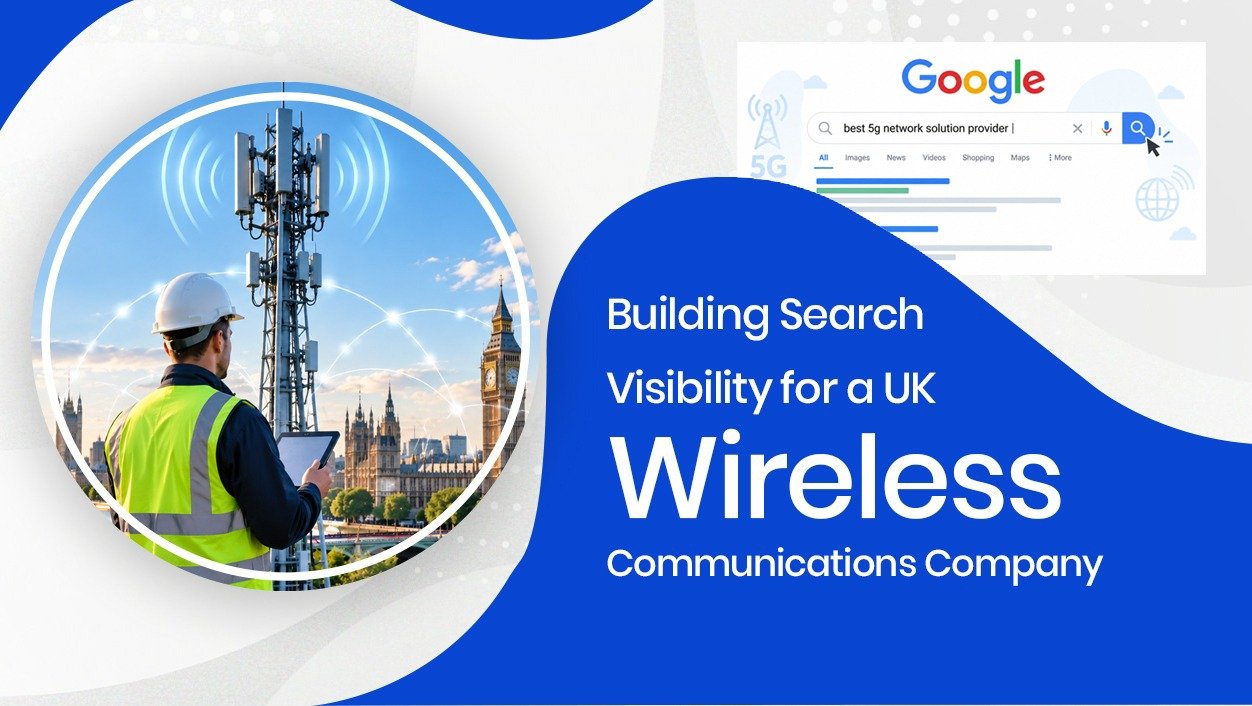
Industry: Wireless Communications TechnologyMarket: UK-based, International B2BServices: Website Development & SEO The Company Our client is a UK-based B2B wireless communications technology company providing connectivity solutions for industrial, commercial and mission-critical environments. Its portfolio spans private 4G and 5G networks, industrial wireless connectivity, Wi-Fi, wireless backhaul and specialist communication solutions across sectors including manufacturing, mining, airports, utilities, construction and logistics. The company had strong technical expertise and a broad portfolio of solutions. The opportunity was to make that expertise more visible online and create a website that could better compete for the searches relevant to its products, technologies and target industries. The Challenge The existing website had significant scope to strengthen both its content and organic search presence. The company’s expertise covered a wide range of technologies and applications, but this was not translating into sufficient visibility across the search terms its potential customers were using. The key challenges were: The goal was not simply to generate more traffic. It was to make the company’s expertise easier to discover when potential customers were actively searching for the technologies and solutions it provides. The Approach Website Development & SEO Retentia Technology worked across the website and SEO to create a stronger digital foundation and expand the company’s search visibility. Strengthening the website Key commercial and industry pages were reviewed and optimised around the company’s solutions and the markets it serves. This included areas such as private wireless, smart cities, enterprise connectivity, airports, highways, mining, manufacturing, construction, ports and utilities. The focus was on creating clearer relevance between each page, its subject matter and the searches it needed to compete for. Expanding search visibility The SEO programme targeted a broader range of relevant searches around: This helped move the website beyond dependence on branded searches and into more specialised technology and industry searches. Building content around expertise Content was developed around specific technical topics and industry applications where the company had genuine expertise. Topics included private 5G, wireless video surveillance, industrial Wi-Fi 6, mining connectivity and remote-site infrastructure. The objective was to create useful content that could reach potential customers researching these technologies before they were necessarily familiar with the company. Strengthening the overall search presence On-page optimisation and off-page SEO supported the website and content strategy, helping build visibility across a wider range of relevant searches. The Results The work resulted in measurable improvements in the company’s organic search presence. 116K Google Search impressions 1.13K Google Search clicks 4.4K Organic Search sessions 43.71% of new users came through Organic Search 17,856 Organic Search events Organic Search became one of the company’s largest acquisition channels, accounting for approximately 4.4K sessions during the measured period. Organic Search also accounted for 43.71% of new users. Google Search Console recorded 116K impressions, 1.13K clicks and an average position of 9.4 during the measured period. From Page 2 to the Top 3 The improvement was particularly visible across targeted search terms. Search term Earlier position Later position Enterprise-grade private 5G network solutions providers 13 1 Private 5G future in logistics 10 3 Benefits of private 5G in logistics 15 3 Wireless network design for airports 15 3 Smart city Wi-Fi solution 25 7 LTE 5G networks solutions 8 3 SDR LTE base station 8 4 Private 5G industrial networks 4 3 These movements demonstrate the expansion of visibility across private 5G, industrial connectivity, airports, smart cities and specialist wireless technologies. Content Expanded the Search Footprint The content programme opened up additional areas of visibility around the company’s specialist expertise. Content covering wireless video surveillance achieved top positions for searches including “Video surveillance 2026 outlook”, “Hybrid wireless surveillance architectures” and “Wireless video for smart cities.” Content around private 5G and public networks also achieved strong rankings across related comparison searches. Content focused on industrial Wi-Fi 6 achieved top positions for searches including “Wi-Fi 6 in industrial environments” and “Industrial wireless network Wi-Fi 6.” Mining-focused content also reached strong positions for searches around wireless networks, mining connectivity and wireless communication in mining. Together, these results helped the website become visible across a broader set of technology and industry searches rather than relying primarily on existing brand demand. The Impact The result was a stronger organic search presence built around the company’s actual areas of expertise. The website gained visibility across specialist searches related to private 5G, industrial wireless, mining, Wi-Fi, wireless surveillance and other connectivity technologies. At the same time, Organic Search became a significant source of new website users, contributing 43.71% of new users during the measured period. The work therefore extended beyond individual keyword rankings. It helped create a stronger connection between the company’s technical expertise, its website and the searches used by potential customers. The Outcome Retentia Technology helped strengthen the company’s website and organic search presence, creating greater visibility across the technologies and industries at the heart of its business. The results included: The result was a more discoverable digital presence for a specialist B2B technology company, with its website reaching a broader audience through the searches that matter to its business. Retentia Technology Website Development & SEO services for B2B Technology Companies
Why Your Website Is Still the Most Valuable Digital Asset in 2026
There was a time when a business website had one obvious job: tell people who you are and give them a way to contact you. That is no longer enough. In 2026, people can discover a business through Google Search, AI-generated answers, LinkedIn, Instagram, YouTube, marketplaces, reviews, referrals and increasingly through conversations with AI assistants. So it is tempting to think the website has become less important. The opposite is happening. The website is becoming the source that everything else depends on. Your social profiles may introduce you. An AI assistant may mention you. Google may surface one of your pages in an answer. A customer may arrive through a review or a referral. But when someone wants to establish whether your business is actually credible, relevant and worth speaking to, they still need somewhere to go deeper. That place is usually your website. And in 2026, its value goes beyond traffic. 1. Your website is the part of your digital presence you control There is an important distinction here. You don’t literally “own” every technical component of a website. Your hosting provider, CMS, domain registrar and other services are still third-party infrastructure. But you control the digital property itself in a way you don’t control a social platform. LinkedIn can change how content is distributed. Instagram can change what appears in someone’s feed. A platform can change its advertising model, algorithms, features or terms. Your website gives you control over the content, structure, navigation, conversion journey and the way your business is represented. That control matters more as the number of channels around your business continues to grow. 2. Your website is no longer just a destination. It is a source. This is one of the biggest changes from the old SEO model. Previously, the objective was relatively simple: get someone to search, rank, get the click and bring them to the website. AI search complicates that journey. A person can now ask a much more detailed question and receive an answer that draws on information from multiple sources. Google has introduced AI Overviews and AI Mode and Google Search Console has begun adding reporting for visibility within generative AI features. That changes what a good website needs to do. It needs to contain information that is clear enough to understand, specific enough to answer real questions, useful enough to be referenced, structured well enough for search systems to interpret and authoritative enough to support trust. Your website is no longer competing only for clicks. It is competing to become part of the answer. 3. Search has changed, but SEO hasn’t disappeared This is where a lot of 2026 marketing advice goes wrong. You will hear that SEO is dead because people are using AI. That is an unnecessary conclusion. Google’s guidance for AI search continues to emphasise the same fundamentals: make content useful, original, accessible and valuable to people. Google also says the practices that help pages perform in traditional Search remain relevant to its AI experiences. What has changed is the type of questions people can ask. Instead of searching for “CRM software UK”, someone might ask, “What should a 100-person UK professional services company look for when replacing spreadsheets with a CRM?” The second query demands a much better answer. That is an opportunity for businesses with genuinely useful websites. 4. A website can answer the questions your sales team keeps hearing Your sales team already knows what prospects ask. How much does implementation take? Which system is right for our business? What happens to our existing data? Can it integrate with our current software? What does implementation actually involve? What mistakes should we avoid? Why are you different from another provider? Those questions should not remain trapped inside sales calls. They can become service pages, comparison pages, FAQs, guides, case studies, implementation pages, industry pages, technical explanations and customer stories. Now the website becomes part of the sales process rather than a brochure sitting beside it. 5. It gives every other marketing channel somewhere credible to lead A LinkedIn post can create interest. An Instagram Reel can create desire. A Google Ad can create a click. An email can create a response. A referral can create curiosity. But none of those channels has to carry the entire burden of explaining the business. The website can. That is why the question shouldn’t be, “Should we invest in social media or our website?” The better question is: Does our website make the rest of our marketing work harder? If it doesn’t, increasing traffic simply sends more people into the same problem. 6. It is where buyers can verify your claims This matters particularly in B2B. Anyone can say, “We’re experts.” A website can show what that actually means. Case studies. Named services. Specific industries. Implementation experience. Customer outcomes. Technical capabilities. People behind the business. Partners and certifications where relevant. Clear explanations. Evidence. That difference becomes even more important when AI can produce convincing marketing language at enormous scale. Specific evidence is becoming more valuable than polished claims. Google’s people-first guidance similarly stresses original information, first-hand expertise, useful analysis and clear signals about who created the content. 7. Your website can build visibility around questions, not just keywords Traditional SEO often became obsessed with phrases such as “ERP software UK”, “CRM consultant” and “accounting software”. Those terms still have value. But they don’t represent the entire search journey. A buyer may search: These are not just keyword opportunities. They are buying questions. A strong website answers them properly. And that gives search engines and AI systems far more useful material to understand and potentially surface. 8. Your website gives AI something substantial to work with This is where GEO becomes relevant. But I would avoid presenting GEO as “add these keywords and ChatGPT will rank you”. There is no credible basis for that. Google’s guidance around generative AI search continues to point towards useful, unique, accessible content rather than a separate set of magic optimisation tricks. So
Website Development for Startups: Everything You Need to Build a Strong Online Presence
Every Startup Begins with an Idea. Growth Begins with Visibility. Every successful startup starts by solving a problem. Sometimes it’s a founder frustrated by an everyday challenge. Sometimes it’s years of industry experience exposing an inefficient process. In other cases, it’s a new way of delivering an existing service faster, cheaper, or more effectively. An idea may be the foundation, but ideas alone don’t build companies. Turning an idea into a business requires product development, customer validation, funding, operations, and one critical element that many founders underestimate: getting discovered by the right people. No matter how innovative your product is, it cannot generate customers if your audience doesn’t know it exists. In today’s market, your digital presence is often your first product. Long before someone books a demo, makes a purchase, or contacts your team, they research your business online. Every search result, website visit, LinkedIn profile, customer review, and social media interaction shapes their perception of your startup. If your digital footprint is weak, your growth will be too. Why Digital Presence Matters More Than Ever Customers no longer discover businesses the way they did a decade ago. They search. They compare. They read reviews. They visit websites. They evaluate credibility within minutes. For startups without an established reputation, your online presence becomes the trust signal that determines whether prospects move forward or move on. A professional digital presence helps you: Without it, even exceptional products struggle to gain traction. The Biggest Challenges Startups Face Without a Digital Presence You’re Invisible to Your Market Launching a business doesn’t automatically create awareness. Potential customers cannot buy from a company they never discover. If your business isn’t visible in search engines or professional channels, competitors become the default choice. Trust Becomes Harder to Earn Today’s buyers verify everything. A missing website, outdated branding, inconsistent information, or inactive social channels immediately raise concerns about credibility. Professional digital assets reassure customers that your business is legitimate, active, and capable of delivering what it promises. Your Competitors Gain the Advantage While you’re focused on building your product, competitors may already be educating your target audience through content, search visibility, social media, and thought leadership. Visibility compounds over time. The longer you delay building your digital presence, the harder it becomes to compete. Growth Remains Limited Personal networks and referrals are valuable, but they eventually plateau. A strong online presence allows your business to attract customers continuously instead of relying solely on introductions or local opportunities. Marketing Becomes More Expensive Businesses without organic visibility often depend heavily on paid advertising. Building search visibility, content authority, and brand recognition early reduces customer acquisition costs over time while creating sustainable growth channels. How a Strong Digital Presence Accelerates Startup Growth Build Trust Before You Sell Your website, content, customer testimonials, and online reputation work together to answer the questions every prospect asks: The stronger these signals, the shorter your sales cycle becomes. Reach Customers Wherever They Are Digital channels remove geographical limitations. Whether your audience is in another city or another country, your business remains discoverable around the clock through search engines, social media, online directories, and digital campaigns. Generate Leads Consistently Unlike traditional marketing, digital marketing creates multiple customer acquisition channels simultaneously. Search engine optimisation, paid advertising, content marketing, email campaigns, and social media work together to generate enquiries even while your team focuses on operations. Learn What Your Customers Want Every website visit, enquiry, download, and conversion provides valuable data. Analytics help startups understand: These insights allow continuous improvement instead of relying on assumptions. Create a Business That Can Scale As startups grow, digital systems grow with them. Online enquiries, automated marketing, customer relationship management, booking systems, and eCommerce platforms allow businesses to serve more customers without increasing operational complexity at the same pace. What Every Startup Website Should Include A startup website isn’t simply an online brochure. It should function as a business development tool. Clear Value Proposition Visitors should immediately understand what your business does, who it’s for, and why it matters. Professional Brand Identity Consistent branding, messaging, typography, and design create confidence and make your business memorable. Mobile-First Experience Most users now discover businesses through mobile devices. Every page should load quickly, display correctly, and provide an intuitive browsing experience across all screen sizes. Search Engine Optimisation Optimising website structure, content, metadata, and page performance helps your business appear when potential customers search for relevant products or services. Fast Performance Website speed directly affects user experience, search rankings, and conversion rates. Visitors expect pages to load within seconds. Clear Calls to Action Every page should guide visitors toward a specific next step, whether that’s booking a consultation, requesting a quotation, scheduling a demo, or making an enquiry. Security and Reliability SSL certificates, secure hosting, regular backups, and software updates protect customer data while reinforcing trust. Analytics and Conversion Tracking Measuring traffic sources, visitor behaviour, and conversion performance helps founders make informed marketing decisions and optimise future growth. The Numbers Behind Digital Success Research consistently shows how important digital presence has become for modern businesses. The digital economy isn’t replacing traditional business. It’s becoming the primary way customers discover it. Final Thoughts The businesses that grow aren’t always the ones with the best ideas. They’re often the ones that communicate their value clearly, build trust quickly, and stay visible wherever their customers are searching. A strong digital presence gives startups more than a professional image. It creates opportunities, generates qualified leads, strengthens credibility, and provides the foundation needed to scale. Whether you’re building a SaaS platform, launching a consultancy, opening a retail business, or introducing a new product to the market, investing in your digital presence from the very beginning gives your startup its best chance to compete, grow, and succeed. This version follows current B2B content standards, removes outdated website-only thinking, avoids repetition, and reads like a modern long-form article rather than a collection of tips. Your Website Is an Investment in Your Startup’s Growth A professionally built website does more