

Your mother needs a knee replacement.
You do not have a list of knee surgeons sitting on your phone. You call a friend. Perhaps they have been through something similar and can give you a doctor’s name. Then you do what most people would do now: you Google it.
You search for the doctor, look at the hospital, check where the specialist consults and read reviews. You search for the procedure, look at another doctor and perhaps search “knee surgeon near me” to compare the names that appear.
You have not booked an appointment yet, but you have already started filtering your options.
That is the part of healthcare marketing many organisations still underestimate. Patients are making decisions about healthcare providers in search long before they make contact with the provider.
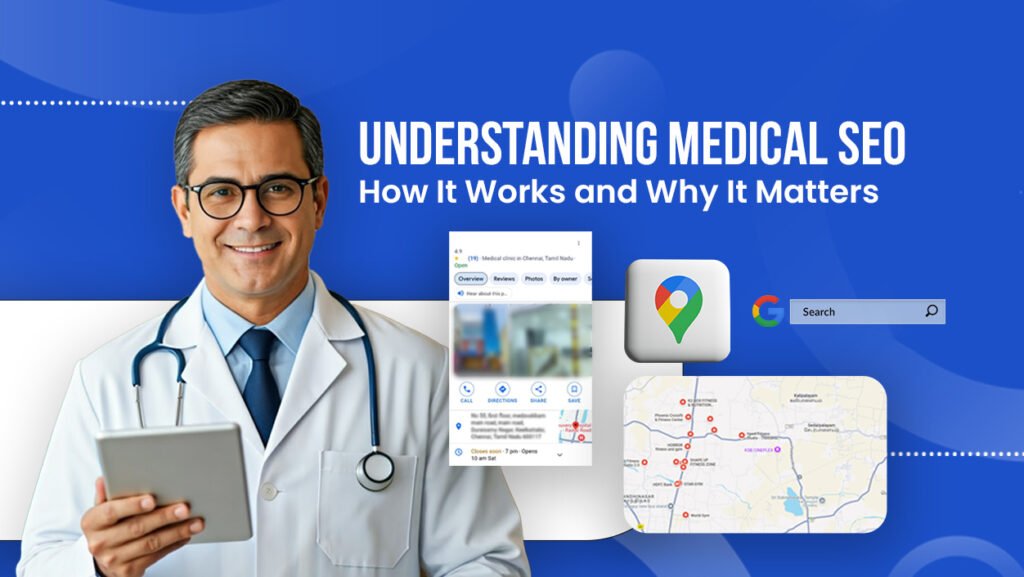
This is where medical SEO earns its place. The job is not simply to make a hospital appear when someone searches its name. It is to make the organisation discoverable when someone is trying to work out what they need, which specialist can help and where they should go.
And in 2026, that search is happening across a more complicated environment, including Google’s AI-powered search experiences.
The question for healthcare organisations is whether the right information appears when the patient is making that decision.
The search starts with a problem, not a hospital name
Think about the searches people actually make:
“Why does my knee hurt when I walk?”
“Should I see an orthopaedic surgeon for knee pain?”
“Knee replacement surgeon near me”, “Dr X reviews” and “Hospital Y knee replacement”.
These are not five versions of the same query. They represent different stages of a decision. The first is about understanding a problem, the second about identifying the appropriate type of care, the third about finding a provider, and the fourth and fifth about evaluating that provider.
A healthcare website needs to account for this progression. Yet many SEO programmes still revolve around a publishing target: ten blogs a month, twenty keywords, another batch of location pages. That can create a large website without creating a particularly useful one.
The question we ask first should be: what does a patient need to know before they are willing to contact this organisation?
That question produces a very different content strategy.
Medical SEO has a higher bar because the subject has consequences
If a product review is inaccurate, someone may waste money. If medical information is inaccurate, the consequences can be considerably more serious.
Google’s guidance reflects this. Health-related subjects fall within areas where strong E-E-A-T matters particularly because the information can affect a person’s health, safety or wellbeing. Google describes these concepts as Experience, Expertise, Authoritativeness and Trustworthiness, with trust given particular importance.
For healthcare organisations, this should change how content is produced. A page about a treatment should not read like generic copy assembled from the first page of Google. Patients should be able to understand where the information comes from and, where appropriate, who wrote or reviewed it. Medical claims need to be handled carefully, references should lead to credible sources, and content that has become outdated needs to be reviewed rather than left online indefinitely because it still generates traffic.
This is particularly important for organisations publishing at scale.
More medical content is not automatically better medical SEO.
If a hospital has 300 health articles but its core treatment pages are weak, its SEO priorities are probably in the wrong order.
The pages closest to the appointment deserve more attention
Take a patient searching for IVF.
They may read about infertility first. They may research IVF success factors and compare treatment approaches. Eventually, however, the search often becomes much more specific: Which fertility clinic should I contact?
This is where the clinic’s own service page becomes important.
A useful IVF page should give the prospective patient enough information to understand the treatment, the clinic, the relevant specialists and the next step. The same principle applies to cardiology, oncology, orthopaedics, ophthalmology, fertility, dentistry or any other speciality.
A strong medical SEO programme should therefore look closely at treatment pages, specialist profiles, location pages, patient pathways and conversion paths.
- Is the treatment page genuinely useful or simply written around a keyword?
- Can someone understand the doctor’s expertise and areas of practice?
- Is it clear where the service is available?
- Can someone understand how consultation, assessment and treatment work?
- Is booking or making an enquiry unnecessarily difficult?
This is where SEO and website strategy meet.
A page can rank and still do a poor job of helping a patient choose the organisation.
Local search is part of provider selection
Now return to the person looking for a knee surgeon.
They may not care who has the most backlinks. They care that the surgeon is accessible, the hospital is credible, the location works for them and the service they need is actually available there.
Google says local results are influenced primarily by relevance, distance and prominence. It also recommends keeping Business Profile information complete and accurate.
That makes local SEO particularly relevant to healthcare. The organisation’s location needs to be clear, services need to be accurately represented, specialist information should agree with what the organisation actually offers, and Business Profile details should be maintained rather than treated as something to set up once and forget.
Reviews matter here too. Google includes reviews within its explanation of local prominence.
But there is an important distinction: do not collect reviews simply because someone told you reviews are an SEO ranking tactic. Patients use them when evaluating providers, which makes reputation management a patient decision issue first and an SEO consideration second.
Medical SEO is changing as search becomes more conversational
Now consider the same patient using a more conversational search:
“My father has persistent knee pain and difficulty walking. What type of specialist should we see and what treatment options might be considered?”
That is very different from searching for a keyword such as “knee surgeon”.
Google is increasingly providing AI-generated responses through features including AI Overviews and AI Mode, allowing users to explore more complex questions directly within Search. Google has also published guidance for website owners on its generative AI search experiences.
This has led to a rush of terminology around GEO, AI SEO and optimisation for generative search.
Healthcare organisations should be careful here. There is no reliable formula that guarantees inclusion in an AI-generated answer. Google’s guidance continues to point towards useful, original, people-first content and established SEO fundamentals.
For medical websites, that means the basics become more important, not less.
A treatment page that clearly explains what the treatment is, identifies the provider, addresses relevant patient questions and is supported by appropriate expertise has genuine value regardless of whether the visitor arrives through a conventional result or an AI-assisted search experience.
AI search changes the interface. It does not remove the need for good information.
Technical SEO is important. It is not the strategy.
Healthcare websites still need proper technical foundations. Search engines need to crawl important pages, users need to access them easily on mobile devices, internal links should connect related treatments, conditions and specialists, and pages should have sensible structures.
Structured data can also help search engines understand information about an organisation and its locations. Google recommends appropriate organisation and local business structured data where applicable.
But technical SEO is frequently given more importance than it deserves in strategy discussions.
A perfectly structured website with weak medical content is still a weak healthcare resource. Schema will not establish a surgeon’s credentials, and page-speed improvements will not explain why one treatment is appropriate for one patient and unsuitable for another.
Technical SEO removes obstacles. It does not create clinical authority.
Stop using traffic as the headline metric
This is another area where healthcare SEO needs a rethink.
Suppose a hospital publishes an article about headache symptoms and it attracts 30,000 visitors. That sounds good. But how many were looking for a hospital? How many were in the organisation’s service area? How many needed the specialist services the hospital actually provides?
Now compare that with a specialist page receiving 1,500 highly relevant visitors and generating consultation enquiries. The second page may be doing far more commercial work.
That is why medical SEO reporting should go beyond rankings and organic sessions. Depending on the organisation, useful measures can include visibility for priority treatments and specialties, organic traffic to service and specialist pages, local search interactions, calls and enquiries originating from organic search, appointment-related actions, engagement with high-value treatment pages, relevant referring domains and mentions, and search visibility across emerging AI experiences where measurement is available.
The right measurement framework depends on the organisation’s patient journey. But one principle should remain constant: SEO performance should eventually be connected to the healthcare organisation’s actual objectives.
What should healthcare organisations do differently?
Start with the website you already have.
Search for your most important treatments. Search for your priority specialists. Search for the locations you serve. Then look at what appears.
Do patients find you? If they do, do they land on a page that actually answers their questions?
- Can they see who provides the service?
- Can they understand the treatment?
- Can they verify the location?
- Can they find a credible explanation of the subject?
- Can they take the next step without unnecessary friction?
Then look at the content library.
Some articles will deserve an update. Some may be too generic to justify further investment. Others may be worth expanding because they support important treatments or specialties.
This is where a proper medical SEO audit should lead: towards decisions about what deserves investment, not simply a longer list of SEO tasks.
Medical SEO is becoming a credibility problem, not just a visibility problem
Go back to that family trying to find a surgeon.
They may have started with a friend’s recommendation and then opened Google. From there, they looked at doctors, hospitals, reviews, treatments, locations and websites. By the time they call, much of the decision-making has already happened.
Healthcare organisations cannot control every part of that journey. They can control the information they put into it.
That means medical SEO should be treated as part of the organisation’s digital credibility, not as a separate traffic-generation activity.
The organisations that take this seriously will build websites that make their expertise visible, explain their services properly and give patients useful information at the point of decision.
That is a more demanding standard than publishing another batch of keyword-targeted articles. It is also a much more useful way to think about medical SEO in 2026.
Looking to strengthen your healthcare presence online?
Whether you are a hospital looking to improve patient discovery or a doctor building a stronger digital presence, Retentia Technology helps healthcare businesses build a more effective digital marketing strategy.
For hospitals: Explore our Digital Marketing for Hospitals
For doctors: Explore our Digital Marketing for Doctors