

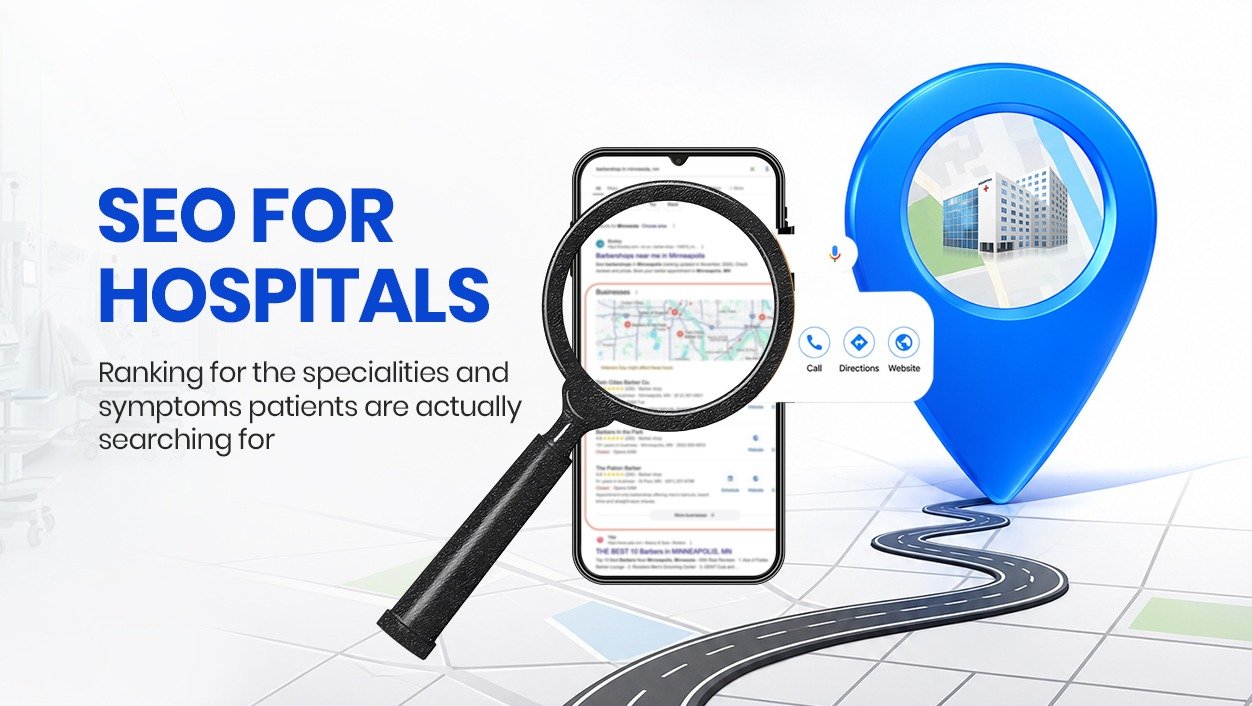
A patient rarely begins their healthcare journey by searching for a hospital name. More often, they start with the problem in front of them: a persistent headache, unexplained stomach pain, knee pain that has started affecting daily life, or a question about whether a particular symptom needs medical attention. The search may then change as they learn more. A symptom becomes a possible condition. A condition leads to a specialty. A specialty leads to a doctor. And eventually, the patient may be looking for a hospital, a location, reviews or an appointment. That progression is important because hospital SEO has traditionally focused heavily on the final part of that journey: hospital names, specialties, treatments and location-based searches. Those searches still matter. But they are only one part of how patients discover and evaluate healthcare providers. In 2026, the opportunity for hospitals is broader. Search is becoming more conversational, AI-powered search experiences are becoming part of the discovery process, local search remains important, and patients have more ways to research a doctor or hospital before taking the next step. The question is no longer simply, “How do we rank our hospital website?” It is: “When a patient starts looking for help, can they find the right information from us at the point they need it?” The patient does not search like your hospital is organised Hospital websites are usually structured around the organisation itself. There is a cardiology department. An orthopaedics department. Gastroenterology. Neurology. Oncology. General surgery. Patients do not necessarily begin with those categories. Someone with recurring knee pain might search for: “Why does my knee hurt when I climb stairs?” Another person may search: “Knee pain when walking but no injury” Later, the same person might search: “Which doctor treats knee pain?” And eventually: “Orthopaedic specialist near me” These are different searches, but they may belong to the same patient journey. Research into online health information seeking has consistently shown that people use search engines to investigate symptoms, conditions and treatment options. The important point for hospitals is not a single percentage or a particular keyword. It is the underlying behaviour: patients often begin with a question about their health before they know exactly what service or specialist they need. That gives hospital marketers a useful way to rethink SEO. Instead of asking only which keywords have search volume, ask what the patient is trying to understand at each stage of the journey. Visual concept: Symptom search → Condition/Specialty research → Doctor evaluation → Appointment & care. This is the first major visual break in the article and should sit here because it explains the central argument before the article moves into strategy. SEO for hospitals starts with search intent, not a keyword list Keyword research still matters. It tells you what people search for, how they phrase their questions and which topics deserve attention. The problem starts when keyword research becomes the strategy itself. A hospital might create a list containing: That list is useful, but it does not tell you what the patient needs from each search. Consider three searches: “Why does my heart race at night?” The person is looking for information and trying to understand a symptom. “Heart palpitations which doctor should I see?” Now the person is trying to connect the problem with a type of medical expertise. “Cardiologist near me” The search is much closer to choosing a provider. Those three searches should not necessarily lead to the same page. A strong hospital website connects them logically. A symptom or condition page can explain the issue responsibly, link to the relevant specialty, introduce appropriate specialists and make the next step clear. That is what search intent looks like when it is applied properly. Build the website around the questions patients actually ask A hospital does not need hundreds of pages simply because hundreds of keywords exist. In fact, creating large volumes of low-value content simply to capture search traffic can work against the principles Google recommends. Google currently emphasises people-first content and specifically warns against producing lots of content primarily to attract search-engine visits or using automation at scale without adding meaningful value. The better approach is to build useful connections between related topics. Take cardiology as an example. A strong specialty section might connect: Cardiology → symptoms → conditions → diagnostic tests → treatments and procedures → relevant doctors → locations → appointment information A patient researching palpitations may need an explanation of the symptom first. Someone already diagnosed with atrial fibrillation may need condition-specific information. Another person may already know they need a cardiologist and simply want to evaluate a particular doctor. The website should accommodate those different levels of intent without forcing everyone through the same journey. This is why information architecture matters so much in hospital SEO. The goal is not to create more pages. The goal is to create the right relationships between pages. Where should a hospital start with SEO? This is probably the question most healthcare teams have once they realise their current website is not performing as well as it should. The answer is not to immediately publish 50 new blogs. Start with what you already have. 1. Audit the existing website Before creating new content, find out what the current website is already doing. Look at the pages receiving organic traffic, the pages generating impressions without meaningful clicks, the service lines with weak visibility, outdated medical information, duplicate or overlapping content, weak doctor profiles and technical issues that may prevent important pages from being properly discovered. This exercise often reveals something interesting: a hospital may already have the expertise and content needed to compete, but that expertise is buried inside pages that are difficult for both patients and search engines to understand. That is an opportunity. 2. Prioritise the specialties that matter A hospital does not need to optimise every department at once. Start with the service lines that combine genuine clinical capability with patient demand and organisational priority. For each one, ask:
Understanding Medical SEO: How It Works and Why It Matters
Your mother needs a knee replacement. You do not have a list of knee surgeons sitting on your phone. You call a friend. Perhaps they have been through something similar and can give you a doctor’s name. Then you do what most people would do now: you Google it. You search for the doctor, look at the hospital, check where the specialist consults and read reviews. You search for the procedure, look at another doctor and perhaps search “knee surgeon near me” to compare the names that appear. You have not booked an appointment yet, but you have already started filtering your options. That is the part of healthcare marketing many organisations still underestimate. Patients are making decisions about healthcare providers in search long before they make contact with the provider. This is where medical SEO earns its place. The job is not simply to make a hospital appear when someone searches its name. It is to make the organisation discoverable when someone is trying to work out what they need, which specialist can help and where they should go. And in 2026, that search is happening across a more complicated environment, including Google’s AI-powered search experiences. The question for healthcare organisations is whether the right information appears when the patient is making that decision. The search starts with a problem, not a hospital name Think about the searches people actually make: “Why does my knee hurt when I walk?” “Should I see an orthopaedic surgeon for knee pain?” “Knee replacement surgeon near me”, “Dr X reviews” and “Hospital Y knee replacement”. These are not five versions of the same query. They represent different stages of a decision. The first is about understanding a problem, the second about identifying the appropriate type of care, the third about finding a provider, and the fourth and fifth about evaluating that provider. A healthcare website needs to account for this progression. Yet many SEO programmes still revolve around a publishing target: ten blogs a month, twenty keywords, another batch of location pages. That can create a large website without creating a particularly useful one. The question we ask first should be: what does a patient need to know before they are willing to contact this organisation? That question produces a very different content strategy. Medical SEO has a higher bar because the subject has consequences If a product review is inaccurate, someone may waste money. If medical information is inaccurate, the consequences can be considerably more serious. Google’s guidance reflects this. Health-related subjects fall within areas where strong E-E-A-T matters particularly because the information can affect a person’s health, safety or wellbeing. Google describes these concepts as Experience, Expertise, Authoritativeness and Trustworthiness, with trust given particular importance. For healthcare organisations, this should change how content is produced. A page about a treatment should not read like generic copy assembled from the first page of Google. Patients should be able to understand where the information comes from and, where appropriate, who wrote or reviewed it. Medical claims need to be handled carefully, references should lead to credible sources, and content that has become outdated needs to be reviewed rather than left online indefinitely because it still generates traffic. This is particularly important for organisations publishing at scale. More medical content is not automatically better medical SEO. If a hospital has 300 health articles but its core treatment pages are weak, its SEO priorities are probably in the wrong order. The pages closest to the appointment deserve more attention Take a patient searching for IVF. They may read about infertility first. They may research IVF success factors and compare treatment approaches. Eventually, however, the search often becomes much more specific: Which fertility clinic should I contact? This is where the clinic’s own service page becomes important. A useful IVF page should give the prospective patient enough information to understand the treatment, the clinic, the relevant specialists and the next step. The same principle applies to cardiology, oncology, orthopaedics, ophthalmology, fertility, dentistry or any other speciality. A strong medical SEO programme should therefore look closely at treatment pages, specialist profiles, location pages, patient pathways and conversion paths. This is where SEO and website strategy meet. A page can rank and still do a poor job of helping a patient choose the organisation. Local search is part of provider selection Now return to the person looking for a knee surgeon. They may not care who has the most backlinks. They care that the surgeon is accessible, the hospital is credible, the location works for them and the service they need is actually available there. Google says local results are influenced primarily by relevance, distance and prominence. It also recommends keeping Business Profile information complete and accurate. That makes local SEO particularly relevant to healthcare. The organisation’s location needs to be clear, services need to be accurately represented, specialist information should agree with what the organisation actually offers, and Business Profile details should be maintained rather than treated as something to set up once and forget. Reviews matter here too. Google includes reviews within its explanation of local prominence. But there is an important distinction: do not collect reviews simply because someone told you reviews are an SEO ranking tactic. Patients use them when evaluating providers, which makes reputation management a patient decision issue first and an SEO consideration second. Medical SEO is changing as search becomes more conversational Now consider the same patient using a more conversational search: “My father has persistent knee pain and difficulty walking. What type of specialist should we see and what treatment options might be considered?” That is very different from searching for a keyword such as “knee surgeon”. Google is increasingly providing AI-generated responses through features including AI Overviews and AI Mode, allowing users to explore more complex questions directly within Search. Google has also published guidance for website owners on its generative AI search experiences. This has led to a rush of terminology around GEO, AI SEO and optimisation

How User-Generated Content Fuels Brand Success?
When was the last time you bought something online without checking what other people had to say about it? You might read reviews before ordering a product, look through customer photos before buying clothes, search Instagram before booking a restaurant or check Reddit before spending money on something unfamiliar. These are now ordinary parts of how people research what to buy. What they are looking for is not another advertisement. They want to know what the product, service or experience is actually like from someone who has been through it. That is where user-generated content (UGC) becomes valuable. A customer review, product photograph, Instagram post, YouTube video, testimonial or online discussion can give prospective buyers information that a brand’s own marketing cannot provide in quite the same way. Research published in the Journal of the Academy of Marketing Science found that consumers generally perceive UGC as more believable than brand communications, while factors such as verification and perceived manipulation can affect how effective that content becomes. The important point is not that every customer post is automatically trustworthy. It is that real customer experiences can become evidence for the next buyer. What is user-generated content? User-generated content is content created by customers, users, fans or members of a community about a brand, product or experience rather than produced as ordinary brand marketing. It can include: There is one distinction worth making in 2026. Organic UGC and paid UGC are not necessarily the same thing. A customer who independently posts a photograph of something they bought is creating organic UGC. A creator who is paid by a brand to produce a customer-style video is creating commissioned content. Both can be useful. But they should not be presented as though they represent the same type of independent customer experience. Why does UGC influence buying decisions? Think about what happens when someone is unsure about a purchase. The questions are rarely limited to “Is this product good?” They are more likely to be: Brand content can answer some of these questions. Customer content can answer others because it comes from the experience of using the product or service. A detailed review saying why someone bought a product, what they liked, what disappointed them and whether they would purchase again gives another buyer something to evaluate. That is more useful than ten reviews simply saying “Amazing product.” The value of UGC is not that it praises the brand. It is that it reduces uncertainty. Different types of UGC serve different purposes Not all UGC does the same job. Reviews and ratings Reviews are particularly useful when someone is already considering a purchase and wants reassurance before committing. A detailed review can address quality, usability, delivery, fit or customer service. It can also reveal objections that the brand may not have considered. Customer photos Customer photographs answer a question that polished product photography cannot always answer: What does this actually look like in real life? This is especially useful for fashion, jewellery, beauty, furniture and other products where scale, colour, fit or appearance can be difficult to judge from studio images. Videos and Reels Video can demonstrate how a product looks, moves, fits or works. For some products, a 20-second customer video can answer more questions than several paragraphs of product copy. Testimonials and customer stories A testimonial becomes more valuable when it explains the situation behind the purchase. What problem did the customer have? Why did they choose the company? What happened afterwards? That is particularly important in B2B, where another company’s experience can help a prospective buyer judge whether a supplier understands a similar situation. Community discussions Reddit threads, forums and social discussions can be less polished but particularly useful. People compare alternatives, discuss problems, share workarounds and explain what they wish they had known before buying. For marketers, those conversations can also reveal the language customers actually use when describing a problem. Where does UGC fit into the customer journey? UGC is not simply a social media tactic. A 2025 review examining 342 studies of UGC found that it can influence different stages of the customer journey, including pre-purchase, purchase and post-purchase behaviour. At the awareness stage, a customer’s post can introduce someone to a product or brand. During research, reviews, videos and community discussions can help them compare options. Closer to purchase, customer photographs, ratings and testimonials can remove the final doubts. After purchase, that same customer may create the next piece of UGC. This creates a useful cycle: Customer experience → customer content → buyer research → purchase → new customer experience That is much more valuable than treating UGC as something to fill an Instagram calendar. Does UGC help SEO? This is where businesses need to be careful. UGC is not an automatic SEO ranking factor. Adding a review section to a page does not guarantee higher rankings. Nor does filling a website with customer comments make a page “optimised”. The opportunity is more practical. Genuine customer content can add first-hand information, answer questions, introduce language customers actually use and make product or service pages more useful. For example, a jewellery brand may describe the size, finish and design of a product. A customer’s photograph can show how large the piece looks when worn. A review might explain how it paired with a particular saree or how the colour appeared in natural light. That additional information can make the page more useful to the person researching the product. Google’s own guidance focuses on helpful, reliable, people-first content rather than content created simply to manipulate search rankings. So the SEO strategy should not be: “Add UGC to rank.” It should be: “Use genuine customer experiences to make important pages more useful.” How can businesses encourage better UGC? The easiest way is to ask at the right time and ask a better question. Instead of: “Please leave us a review.” Ask: Specific questions tend to produce information that other customers can actually use. For visual products, ask customers to share