
Search is changing. People still use Google to discover websites, products and services, but they are increasingly turning to AI-powered search experiences to ask questions, compare options and find recommendations.
For businesses, this raises an important question: Is there a difference between SEO and Ai search ? How do you make your website visible in both traditional search results and AI-generated answers?
The answer starts with understanding how SEO works today, which established practices still matter, and what AI search adds to the picture.
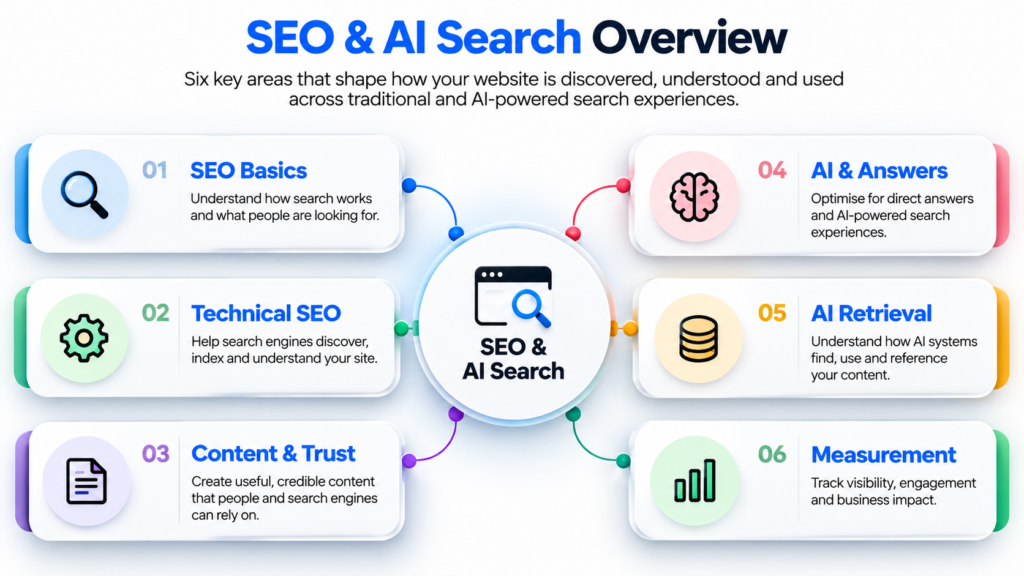
1. SEO Basics: How Search Works
Search engine optimisation (SEO) helps search engines discover, understand and present relevant website content to people searching for information, products or services.
Before exploring AI search, it is important to understand the foundations on which traditional SEO is built.
Keywords
Keywords are the words and phrases people use when searching online. They help marketers understand what their audience wants to find.
For example, someone looking for an IT asset disposal provider might search for:
- ITAD software
- IT asset disposal services
- IT asset tracking software
- How to dispose of old business computers securely
These searches relate to the same broad subject, but they indicate different needs.
Why it matters: Keyword research helps identify relevant topics, understand demand and plan pages around real user needs. The goal is not to repeat a phrase as often as possible; it is to provide the right information for the search.
Search Intent
Search intent is the purpose behind a search query. Understanding it helps determine what type of content a page should provide.
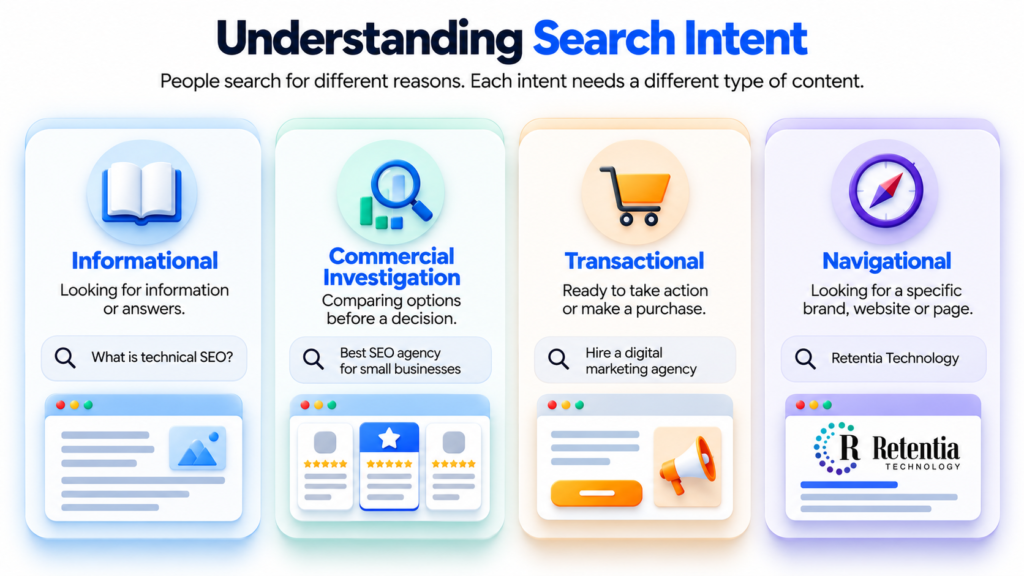
These categories can overlap. Someone searching for software may want to understand the category before comparing providers.
Practical takeaway: Before creating a page, ask what the searcher is trying to accomplish. Then make sure the page satisfies that need.
Organic Search
Organic search refers to unpaid results displayed by a search engine. It is different from paid advertising.
A business may attract organic visitors through product pages, service pages, educational articles and other useful resources.
Organic visibility can support long-term discovery, but rankings and traffic are not guaranteed. Competition, relevance, website quality and many other factors influence performance.
SERP: Search Engine Results Page
A search engine results page, or SERP, is the page displayed after someone submits a query.
It may include traditional website listings, advertisements, featured snippets, image results, local business listings, videos and AI-generated features, depending on the query and search platform.
This matters because ranking position alone does not tell the entire story. The types of results displayed can affect how people discover and interact with your website.
Long-Tail Keywords
Long-tail keywords are more specific search phrases, often expressing a clear question or requirement.
Compare:
- “SEO”
- “SEO for small manufacturing businesses”
- “How can a manufacturing company improve organic search visibility?”
The more specific queries may represent a narrower audience, but they can reveal more about the searcher’s needs.
Practical takeaway: Build content around meaningful customer questions rather than focusing exclusively on broad, high-volume keywords.
2. Technical SEO: Making Your Website Discoverable
Useful content cannot perform effectively in search if search engines cannot access or understand the relevant pages.
Technical SEO focuses on the website infrastructure and signals that support crawling, indexing and usability.
Crawling
Crawling is the process through which search engine bots discover and access URLs.
Search engines may discover pages through links, sitemaps and other sources. A page that is difficult to access or discover may be less likely to be crawled.
For example, a business might publish a valuable service page but fail to link to it from relevant parts of the website. Visitors and search engines may have difficulty finding it.
What to check: Important pages should be accessible, linked appropriately and not unintentionally blocked from crawling.
Indexing
Indexing is the process of analysing and storing information about pages so that they may be eligible to appear in search results.
Crawling and indexing are not the same thing. A search engine can crawl a page without choosing to index it.
Common issues include accidental noindex directives, duplicate URLs, weak or repetitive content, and technical problems that prevent proper processing.
What to check: Use Google Search Console to investigate whether important pages are indexed and identify relevant indexing issues.
XML Sitemap
An XML sitemap provides search engines with information about URLs that a website considers important.
It can help with URL discovery, particularly on large websites or websites with complex structures.
However, submitting a sitemap does not guarantee that every listed page will be crawled or indexed.
Practical example: A website that regularly publishes new resources should maintain an accurate sitemap and ensure it reflects the URLs it wants search engines to consider.
Canonical URL
A canonical URL identifies the preferred version of a page when similar or duplicate URLs exist.
For example, tracking parameters may create several URLs that display essentially the same content. Canonical signals help search engines understand which version should generally be treated as primary.
Canonicalisation is not a universal solution for every duplicate-content issue. It must be implemented consistently with the website’s URL structure and other signals.
Structured Data
Structured data is information added to a page in a standardised format, often using Schema.org vocabulary.
It can help search engines understand details such as an organisation, article, product or breadcrumb navigation.
For example, appropriate Article structured data can identify the headline, author and publication information associated with an article.
Structured data must accurately represent visible page content and follow the relevant platform’s requirements. It does not guarantee a rich result, a higher ranking or inclusion in an AI answer.
Core Web Vitals
Core Web Vitals are metrics that assess aspects of real-world page experience:
- Largest Contentful Paint (LCP): Measures how quickly the main content becomes visible.
- Interaction to Next Paint (INP): Measures responsiveness to user interactions.
- Cumulative Layout Shift (CLS): Measures unexpected visual movement during loading.
A website that loads slowly, responds poorly or shifts unexpectedly can frustrate users.
Core Web Vitals are part of Google’s page experience considerations, but good scores alone do not guarantee high rankings.
Practical takeaway: Technical SEO should make the website accessible, understandable and usable. It is a foundation for search performance, not a substitute for useful content.
3. Content & Trust: Why Your Website Deserves Attention
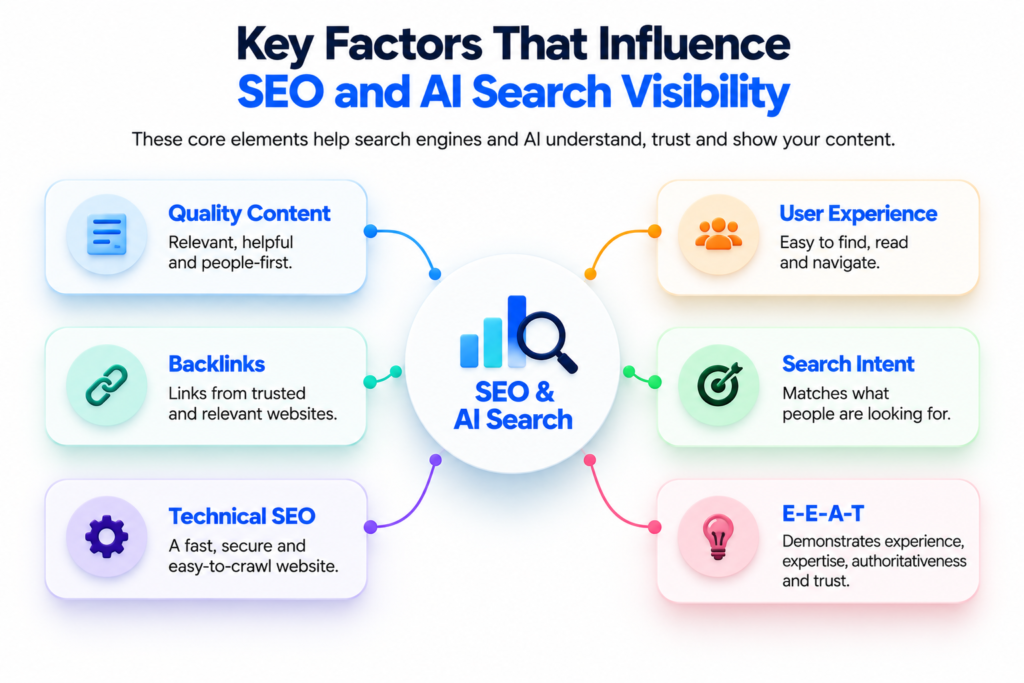
Search engines need to identify content that is relevant to a query. Readers need reasons to trust what they find.
Content quality, expertise, evidence and clarity therefore remain central to an effective search strategy.
Helpful Content
Helpful content directly addresses a real need and provides enough information for the reader to make progress.
A page explaining how to select ITAD software, for example, could cover asset tracking, reporting, chain of custody, data destruction records and the questions a buyer should ask vendors.
A weak alternative would repeat generic statements about the benefits of software without explaining how to evaluate it.
Useful content does not have to be long. Its depth should match the subject and the reader’s needs.
A useful test: After reading the page, can someone answer their original question more confidently than before?
E-E-A-T: Experience, Expertise, Authoritativeness and Trustworthiness
E-E-A-T is a framework used in Google’s Search Quality Rater Guidelines to assess qualities associated with high-quality content.
It stands for:
- Experience: First-hand involvement with the subject, where relevant.
- Expertise: Knowledge or skill in the subject.
- Authoritativeness: Recognition as a credible source on the topic.
- Trustworthiness: The reliability and honesty of the content, website and organisation.
E-E-A-T is not a single score that website owners can optimise directly. Google uses multiple systems and signals to assess content quality.
Businesses can nevertheless demonstrate these qualities through genuine experience, accurate information, named authors, credible sources and transparent business information.
Originality and First-Hand Experience
Publishing information that already exists across dozens of websites provides readers with little reason to choose your page.
Originality can come from:
- First-hand experience with a product or process.
- Expert commentary.
- Original research or survey findings.
- Practical demonstrations.
- Carefully documented examples.
- A useful analysis of a difficult business problem.
For example, an article about technical SEO becomes more valuable when it explains a real indexing problem, how it was diagnosed and what the evidence showed.
Do not invent case studies or results to make an article appear authoritative. If a claim cannot be verified, qualify it or leave it out.
Topical Authority
Topical authority describes the perceived depth and credibility a website develops around a subject. It is commonly used in SEO strategy, but it is not a single, publicly measurable Google ranking score.
A website may demonstrate depth by publishing a well-connected set of useful resources on a particular subject.
For example, a website focused on ITAD software might cover asset tracking, data sanitisation records, audit trails, compliance workflows and end-of-life asset management.
The objective is not to publish as many articles as possible. Each page should serve a distinct purpose and contribute useful information.
Internal Linking
Internal links connect one page of a website to another page on the same website.
They help visitors find related information and help search engines discover pages and understand relationships between content.
For example, a guide explaining IT asset disposal could link to a relevant software page, a data destruction guide and an article about chain of custody.
Use descriptive anchor text that tells readers what to expect. Avoid adding links merely to repeat keywords.
Content Freshness
Some subjects change frequently, while others remain stable for years.
An article about a current regulation, software feature or reporting requirement may need regular verification. A basic explanation of a long-established concept may not.
Updating a page simply to change its publication date does not make it more useful.
Practical takeaway: Review content when the underlying facts, guidance or user needs change. Preserve accurate material and improve the parts that genuinely need attention.
4. AI & Answers: How Search Is Evolving
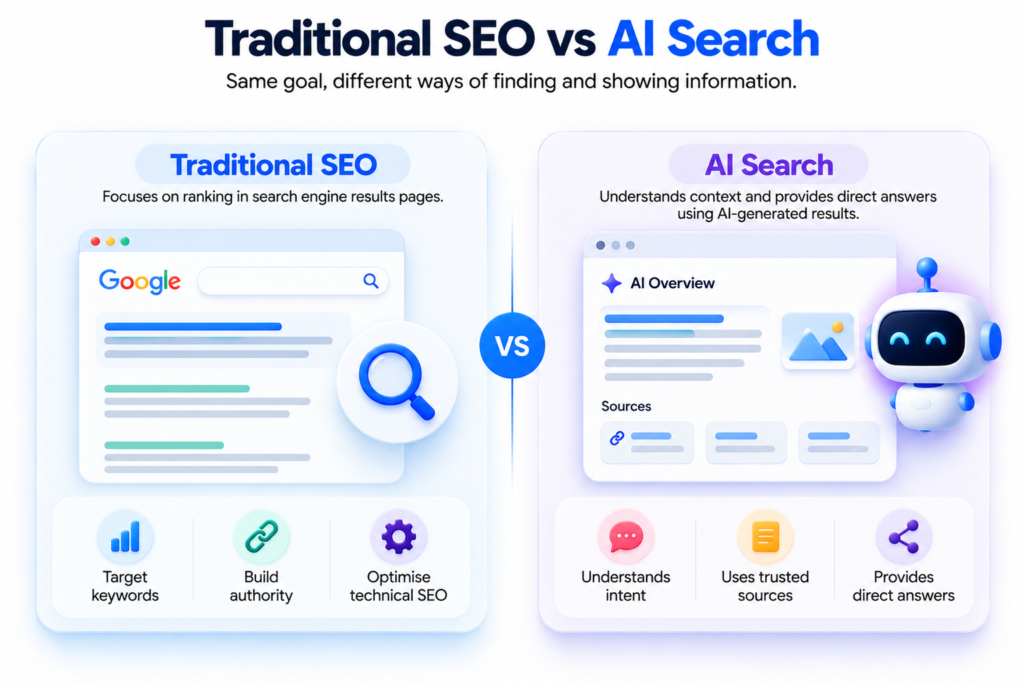
AI-powered search experiences can summarise information, answer questions and reference sources. This changes how people may encounter a business, even when they do not immediately visit its website.
It has also led to several overlapping optimisation terms.
AEO: Answer Engine Optimisation
Answer Engine Optimisation, commonly abbreviated as AEO, refers to efforts to make content useful and discoverable in systems that provide direct answers to questions.
The term is used inconsistently across the industry. Some practitioners focus on featured snippets and question-based results; others use it more broadly for AI answer platforms.
Practical work often includes:
- Answering relevant questions directly.
- Using clear headings.
- Providing accurate supporting details.
- Making the source of important claims clear.
- Organising related information logically.
These practices can improve usability and clarity, but there is no universal AEO technique that guarantees a direct answer placement.
GEO: Generative Engine Optimisation
Generative Engine Optimisation, or GEO, describes strategies intended to improve a brand’s or website’s visibility in generative AI responses.
These responses may combine information from multiple sources instead of displaying only a conventional list of links.
For a business, the practical objective might be to ensure that its expertise, products and relevant supporting information are represented accurately when AI systems answer questions in its category.
GEO is an emerging industry term, not a universally standardised set of ranking rules.
SEO vs AEO vs GEO
These terms are useful for discussing different visibility goals, but they should not be treated as three completely independent disciplines.
| Term | Main focus | Practical question |
| SEO | Visibility in search engines | Can people discover the relevant page? |
| AEO | Visibility in direct answers | Does the content answer the question clearly? |
| GEO | Visibility in generative AI responses | Could the content be useful and eligible to be referenced in an AI-generated answer? |
There is substantial overlap. Good technical accessibility, useful content and clear explanations can support more than one of these goals.
What businesses should avoid: Buying into claims that a special file, a particular word count or a secret optimisation trick guarantees AI citations. No credible strategy can promise that outcome.
AI Overviews and AI Search Experiences
AI Overviews and other AI-powered search features can provide generated summaries alongside, or in place of some conventional search interactions.
Their presence and format depend on the platform, query and product configuration.
These features may change the visibility of traditional listings and the way people interact with search results. For some queries, users may get the information they need without visiting a website. For others, they may follow source links to investigate further.
This means businesses should assess both visibility and the outcomes that matter to them, rather than assuming every search impression will produce a click.
Featured Snippets
Featured snippets are selected search-result excerpts that aim to answer a query directly. They may appear as a paragraph, list, table or another format.
They are different from AI-generated summaries, although both can surface information that answers a question.
Clear explanations and appropriately structured content may help search engines interpret a page. There is no special markup that guarantees a featured snippet.
Zero-Click Searches
A zero-click search is a search interaction in which the user does not click through to an external website.
This can happen when the results page itself provides enough information, such as a quick factual answer, a local business detail or an AI-generated summary.
Zero-click behaviour is not necessarily the same as a failed marketing outcome. A user may learn about a brand or service without visiting the website.
However, businesses that depend on organic visits should pay attention to whether search visibility is translating into qualified traffic, enquiries and conversions.
Practical takeaway: Treat AI search as an evolving discovery environment. Build reliable content, monitor actual visibility where measurement is available, and avoid assuming that a mention automatically generates business.
5. AI Retrieval: How Information Can Reach AI Systems
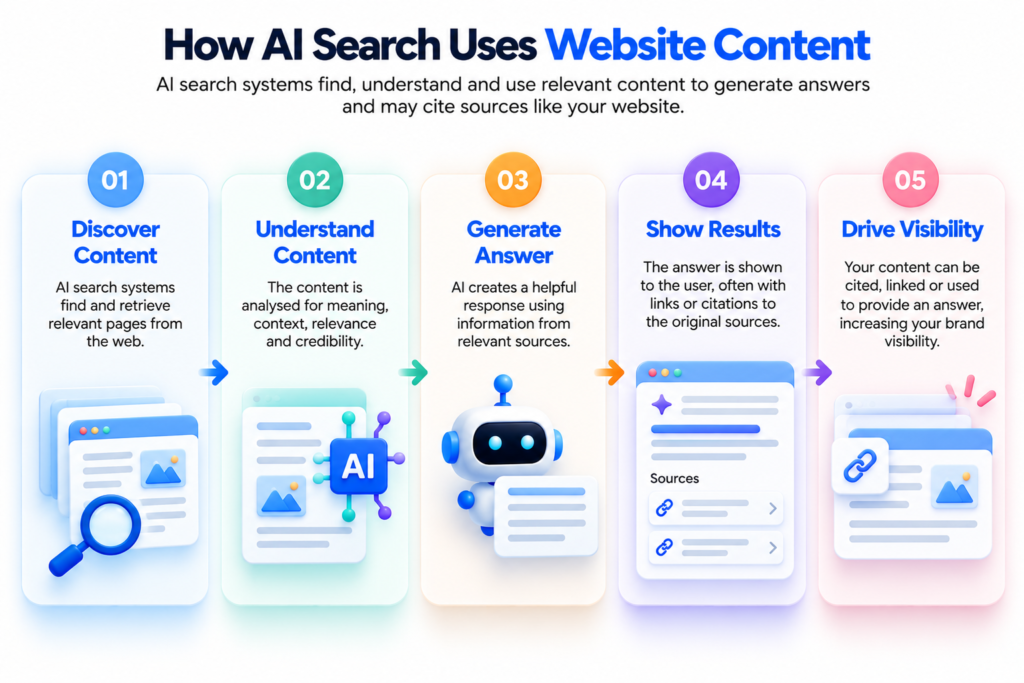
Understanding AI search requires distinguishing between a model’s existing knowledge and information retrieved from external sources.
Different AI products use different architectures. Not every answer is generated through the same retrieval process.
Retrieval-Augmented Generation (RAG)
Retrieval-Augmented Generation, or RAG, is an approach in which a system retrieves relevant information from an external source or knowledge collection and uses it to help generate a response.
A simplified process looks like this:
- A person asks a question.
- The system searches an available information source.
- It selects information considered relevant.
- A language model uses that information to help produce an answer.
For example, a business assistant might retrieve relevant product documentation before answering a question about a software feature.
Web search can also provide external information to AI-powered experiences, but the precise process varies by system.
Why it matters: Information must be available to the system and relevant to the question before it can be used through retrieval. Publishing a page does not guarantee that any particular AI system will retrieve it.
Retrieval vs Generation
Retrieval and generation are different tasks.
Retrieval identifies potentially relevant information from an available collection or source.
Generation produces a response, often by combining context with the model’s learned capabilities.
A system may retrieve several documents and then generate a concise answer. It may also answer from its existing model knowledge without retrieving external information for that particular response.
This distinction explains why being present on the web and being cited in a specific AI answer are not the same thing.
Entities and Relationships
An entity is a distinct person, organisation, product, place or concept that can be identified and discussed.
Relationships describe how entities connect.
For example, a company may provide a software product that supports asset tracking for a particular industry. A clear website can explain the company, the product, its capabilities and the problems it addresses.
Consistent names, detailed product descriptions, credible references and appropriate structured data can help systems interpret these relationships.
However, entity optimisation is not a guarantee of AI visibility. Different systems use different sources and methods to interpret information.
Structured, Clear and Self-Contained Information
A page is easier to understand when its sections communicate clear ideas.
Compare these two approaches:
Vague: “Our advanced platform enables next-generation operational excellence.”
Specific: “The platform records asset movements and maintains an audit trail of changes.”
The second statement communicates a concrete capability. If accurate, it is also easier for a reader to evaluate.
Useful content can include concise answers, descriptive headings, supporting explanations and clearly attributed evidence. These elements help readers and may help automated systems interpret the page.
There is no requirement that every paragraph follow a rigid answer template.
AI Crawlers and Access
Some AI-related services use automated crawlers to discover or retrieve web content. Their access rules and purposes differ.
Website owners should understand which services they want to permit, what their robots.txt rules do, and whether important pages require authentication or other access restrictions.
Allowing a crawler does not guarantee that a page will be indexed, retrieved, used for training or cited in an answer. These are different activities, and individual services have their own policies.
Do not block all automated access indiscriminately without understanding the consequences. Equally, do not assume every crawler needs access to every part of a website.
Citations and Source Selection
Some AI search experiences provide citations or links to sources used in an answer. Others may provide limited or no visible source attribution.
Source selection can depend on the question, available information, relevance, system design and other factors.
Businesses can improve the quality of their published information, provide evidence for claims and make important facts clear. They cannot force an AI system to cite a particular page.
Practical takeaway: Focus on making important information accessible, accurate and understandable. Treat retrieval and citations as outcomes to observe, not outcomes that can be guaranteed through a formula.
6. Measurement: Knowing Whether SEO Is Working
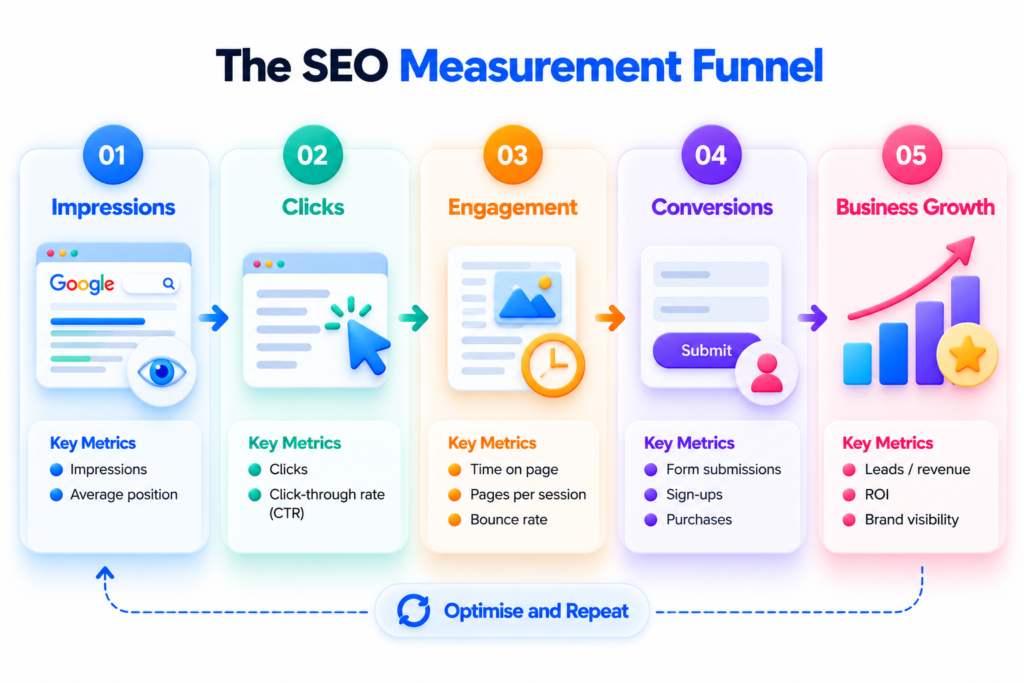
SEO activity should be evaluated against observable results. Publishing articles, improving technical elements and monitoring AI visibility are activities; they are not proof of business success on their own.
Google Search Console
Google Search Console provides information about how a website performs in Google Search.
Depending on the report and property, it can show metrics such as:
- Impressions: How often a page or property appeared in search results.
- Clicks: How often users clicked through from those results.
- Click-through rate (CTR): The proportion of impressions that resulted in clicks.
- Average position: An aggregated measure of ranking position for reported results.
Search Console also helps website owners investigate indexing, sitemap and other search-related issues.
These metrics need context. A page can receive more impressions but a lower CTR, for example, because its visibility expanded to a broader range of queries.
Google Analytics
Google Analytics helps measure what happens after people arrive at a website.
Depending on the implementation, reports can include acquisition sources, engagement, key events and conversions.
For example, an SEO article might attract visitors, but its business value depends partly on what those visitors do next. They may read another page, request a consultation, submit a form or leave without taking further action.
Correct measurement setup matters. If conversion events are missing or incorrectly configured, the reports may not reflect actual outcomes.
Rankings, Traffic and Conversions
These metrics answer different questions.
| Metric | What it helps you understand |
| Rankings | Where pages appear for selected searches |
| Impressions | Whether pages are appearing in search results |
| Organic clicks | Whether searchers are visiting the website |
| Engagement | How visitors interact with the site |
| Leads and conversions | Whether visits produce meaningful actions |
| Revenue or pipeline | Whether marketing contributes to business outcomes |
No single metric tells the whole story. Rankings can improve without producing more qualified leads, and traffic can increase without improving revenue.
AI Search Visibility
Measuring visibility in AI-generated responses is more complicated because reporting varies by platform.
Possible approaches include:
- Checking whether a brand appears in a defined set of relevant questions.
- Recording whether a website is cited in those responses.
- Monitoring referral traffic from identifiable AI platforms.
- Reviewing qualified leads and conversions associated with those visits, where attribution is available.
Manual checks can be inconsistent because responses may vary by time, location, account, wording and system updates. Third-party monitoring tools also differ in their methods and coverage.
Treat such measurements as indicators, not complete representations of all AI activity.
Attribution
Attribution is the process of understanding how different interactions contribute to a conversion.
A person might first discover a business through organic search, later read an article shared on LinkedIn, and eventually submit a contact form directly.
A single last-click report may credit only the final interaction. A broader analysis may reveal that earlier content helped with discovery or evaluation.
Attribution has limitations, especially when people switch devices, use different platforms or interact with a business offline.
Practical takeaway: Combine search visibility, website behaviour and business outcomes. Establish a baseline before making changes, then evaluate whether those changes produce meaningful improvements.
A Practical Starting Plan
Understanding terminology is useful, but it should lead to action. A business does not need to implement every technique at once.
Step 1: Check the Foundations
Review the important pages on your website.
- Can search engines access them?
- Are the pages you want indexed actually eligible for indexing?
- Do important pages have clear titles and headings?
- Do internal links help visitors discover related content?
- Does the site work well on mobile devices?
Resolve significant technical problems before investing heavily in expanding content.
Step 2: Identify the Questions Your Audience Asks
Use keyword research, customer conversations, sales enquiries and relevant search data to identify genuine information needs.
Separate questions that require different answers. A person learning about a subject may need an educational guide, while someone evaluating a solution may need a detailed service page or comparison.
Step 3: Improve Existing Content Before Producing More
Review your most important pages.
Remove unsupported claims, correct outdated information, clarify vague statements and fill gaps that prevent readers from making informed decisions.
Add original examples and evidence where you have them. Do not create artificial expertise or invented case studies.
Step 4: Connect Related Pages
Build a logical internal linking structure so readers can move from an introductory explanation to a more detailed guide, product page or relevant service.
Each page should have a clear purpose. Avoid creating several pages that compete to answer exactly the same query without a reason for the distinction.
Step 5: Measure a Baseline
Record current search impressions, clicks, relevant rankings, traffic and conversions where reliable data is available.
If you intend to measure AI search visibility, define the questions and platforms you will monitor. Keep the method consistent enough to compare observations over time.
Step 6: Review and Improve
Use the evidence to decide what to do next.
A page with strong impressions but few clicks may need a clearer title or a better match with search intent. A page that attracts relevant traffic but produces no enquiries may need a closer look at the visitor’s needs and the next step offered.
Do not assume every underperforming page needs more keywords. Diagnose the problem before changing the content.
Final Thoughts
SEO and AI search share an important objective: helping people discover useful information. The technologies and presentation formats may differ, but businesses still need accessible websites, relevant content and credible information.
The terminology will continue to evolve. Some concepts describe established technical practices; others are industry labels for emerging approaches or overlapping goals.
You do not need to adopt every new acronym to build a sound strategy.
Start with the fundamentals, understand how your audience searches, make your content genuinely useful and measure what happens. Then adapt your approach as reliable evidence about search behaviour and platform capabilities develops.
The goal is not to optimise for every term. It is to make your business easier to discover, understand and trust.
Further Reading
- Google Search Central: AI features and your website
- Google Search Central: Creating helpful, reliable, people-first content
- Google Search Central: Introduction to structured data
- Google Search Console Help
- Google Analytics Help