

A patient rarely begins their healthcare journey by searching for a hospital name. More often, they start with the problem in front of them: a persistent headache, unexplained stomach pain, knee pain that has started affecting daily life, or a question about whether a particular symptom needs medical attention.
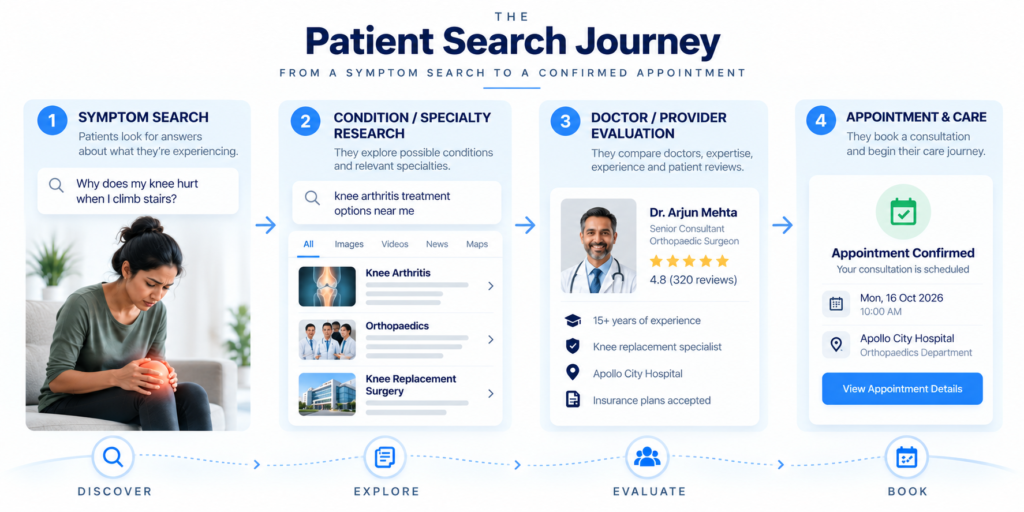
The search may then change as they learn more. A symptom becomes a possible condition. A condition leads to a specialty. A specialty leads to a doctor. And eventually, the patient may be looking for a hospital, a location, reviews or an appointment.
That progression is important because hospital SEO has traditionally focused heavily on the final part of that journey: hospital names, specialties, treatments and location-based searches. Those searches still matter. But they are only one part of how patients discover and evaluate healthcare providers.
In 2026, the opportunity for hospitals is broader. Search is becoming more conversational, AI-powered search experiences are becoming part of the discovery process, local search remains important, and patients have more ways to research a doctor or hospital before taking the next step.
The question is no longer simply, “How do we rank our hospital website?”
It is:
“When a patient starts looking for help, can they find the right information from us at the point they need it?”
The patient does not search like your hospital is organised
Hospital websites are usually structured around the organisation itself.
There is a cardiology department. An orthopaedics department. Gastroenterology. Neurology. Oncology. General surgery.
Patients do not necessarily begin with those categories.
Someone with recurring knee pain might search for:
“Why does my knee hurt when I climb stairs?”
Another person may search:
“Knee pain when walking but no injury”
Later, the same person might search:
“Which doctor treats knee pain?”
And eventually:
“Orthopaedic specialist near me”
These are different searches, but they may belong to the same patient journey.
Research into online health information seeking has consistently shown that people use search engines to investigate symptoms, conditions and treatment options. The important point for hospitals is not a single percentage or a particular keyword. It is the underlying behaviour: patients often begin with a question about their health before they know exactly what service or specialist they need.
That gives hospital marketers a useful way to rethink SEO.
Instead of asking only which keywords have search volume, ask what the patient is trying to understand at each stage of the journey.
Visual concept: Symptom search → Condition/Specialty research → Doctor evaluation → Appointment & care.
This is the first major visual break in the article and should sit here because it explains the central argument before the article moves into strategy.
SEO for hospitals starts with search intent, not a keyword list
Keyword research still matters. It tells you what people search for, how they phrase their questions and which topics deserve attention.
The problem starts when keyword research becomes the strategy itself.
A hospital might create a list containing:
- cardiology hospital
- cardiologist
- heart specialist
- cardiology treatment
- cardiology hospital near me
- best cardiologist
That list is useful, but it does not tell you what the patient needs from each search.
Consider three searches:
“Why does my heart race at night?”
The person is looking for information and trying to understand a symptom.
“Heart palpitations which doctor should I see?”
Now the person is trying to connect the problem with a type of medical expertise.
“Cardiologist near me”
The search is much closer to choosing a provider.
Those three searches should not necessarily lead to the same page.
A strong hospital website connects them logically. A symptom or condition page can explain the issue responsibly, link to the relevant specialty, introduce appropriate specialists and make the next step clear.
That is what search intent looks like when it is applied properly.
Build the website around the questions patients actually ask
A hospital does not need hundreds of pages simply because hundreds of keywords exist.
In fact, creating large volumes of low-value content simply to capture search traffic can work against the principles Google recommends. Google currently emphasises people-first content and specifically warns against producing lots of content primarily to attract search-engine visits or using automation at scale without adding meaningful value.
The better approach is to build useful connections between related topics.
Take cardiology as an example.
A strong specialty section might connect:
Cardiology
→ symptoms
→ conditions
→ diagnostic tests
→ treatments and procedures
→ relevant doctors
→ locations
→ appointment information
A patient researching palpitations may need an explanation of the symptom first. Someone already diagnosed with atrial fibrillation may need condition-specific information. Another person may already know they need a cardiologist and simply want to evaluate a particular doctor.
The website should accommodate those different levels of intent without forcing everyone through the same journey.
This is why information architecture matters so much in hospital SEO.
The goal is not to create more pages. The goal is to create the right relationships between pages.
Where should a hospital start with SEO?
This is probably the question most healthcare teams have once they realise their current website is not performing as well as it should.
The answer is not to immediately publish 50 new blogs.
Start with what you already have.
1. Audit the existing website
Before creating new content, find out what the current website is already doing.
Look at the pages receiving organic traffic, the pages generating impressions without meaningful clicks, the service lines with weak visibility, outdated medical information, duplicate or overlapping content, weak doctor profiles and technical issues that may prevent important pages from being properly discovered.
This exercise often reveals something interesting: a hospital may already have the expertise and content needed to compete, but that expertise is buried inside pages that are difficult for both patients and search engines to understand.
That is an opportunity.
2. Prioritise the specialties that matter
A hospital does not need to optimise every department at once.
Start with the service lines that combine genuine clinical capability with patient demand and organisational priority.
For each one, ask:
- What conditions do we treat?
- What symptoms lead patients to this service?
- What procedures or treatments do we provide?
- Which doctors should patients be able to find?
- Which locations provide the service?
- What questions do patients have before booking?
- What is the appropriate next step after reading the information?
The answers become the foundation of the content architecture.
This is much more useful than creating a keyword list and asking a writer to produce an article for every phrase.
3. Map symptoms to specialties
Once the priority service lines are identified, map the questions that sit around them.
For an orthopaedic department, that might include questions around knee pain, back pain, joint stiffness, sports injuries, fractures or recovery after surgery.
The content should not attempt to diagnose the reader. Instead, it should explain the topic accurately, help the reader understand when professional assessment may be appropriate, and connect the information to the relevant clinical service.
That distinction matters particularly in healthcare.
Google treats health-related subjects as part of its YMYL environment and says its systems place greater emphasis on strong E-E-A-T signals for topics that can significantly affect people’s health and wellbeing. Google also makes clear that E-E-A-T itself is not a single ranking factor.
For a hospital, that means content quality cannot be separated from clinical responsibility.
Your doctors are part of your search presence
There is another important asset sitting inside most hospitals that is often underused in search strategy:
the doctor profile.
Many hospital websites treat doctor pages as online CVs.
Name. Qualification. Designation. Photograph. Perhaps a list of procedures.
That is useful, but it does not necessarily answer the patient’s actual question:
“Is this the right doctor for my problem?”
A stronger profile can explain the doctor’s specialty, clinical interests, conditions treated, procedures performed, professional qualifications, hospital locations and how to arrange a consultation.
It can also connect naturally with relevant service and condition pages.
For example, a patient reading about knee replacement should be able to discover the orthopaedic specialists who perform that procedure. A patient researching atrial fibrillation should be able to move naturally towards the relevant cardiology expertise.
This creates a network rather than a collection of disconnected pages.
It is also worth making authorship transparent on medical content. Google recommends clear information about who created content, including accurate bylines where readers would reasonably expect them.
For healthcare organisations, that can be supported by a clear editorial and clinical review process.
Medical content needs more than keywords
This is where healthcare SEO differs from many other industries.
A page can be technically well optimised for a phrase such as “appendicitis symptoms” and still be a poor healthcare resource.
Patients need information they can trust.
That means hospitals should have a process for deciding:
- who writes medical content
- who clinically reviews it
- how sources are selected
- how frequently important information is checked
- how outdated content is identified
- how authorship and review are displayed
The role of AI also needs to be considered carefully.
AI can help a marketing team organise research, identify questions, develop outlines or improve clarity. But using AI to mass-produce generic medical articles is not a substitute for clinical expertise.
Google’s guidance does not say that AI-generated content is automatically penalised. Its concern is whether content is created primarily for people and provides genuine value, rather than being produced at scale primarily to manipulate search rankings.
That is an important distinction.
The problem is not the tool used to produce content. The problem is content that has nothing useful to say.
What has AI search actually changed?
There is a lot of noise around AI search, particularly around terms such as AEO and GEO.
For hospitals, the practical change is easier to understand.
Patients can now ask longer, more conversational questions and receive AI-generated responses that bring together information from multiple sources. Google says AI Overviews and AI Mode can help people explore more complex questions, and its current guidance says the same foundational SEO practices remain relevant for these experiences. There are no additional technical requirements specifically for appearing in AI Overviews or AI Mode.
That is an important correction to some of the more exaggerated claims around AI SEO.
Hospitals do not need a secret piece of “AI schema”.
They do not need to rebuild their website around a new technical format.
Google explicitly says there are no special schema or additional machine-readable files required to appear in its AI search features. The fundamentals remain: crawlable pages, useful content, internal linking, good page experience, textual content, relevant media and structured data that accurately matches what users can see on the page.
What has changed is the way patients can discover and explore information.
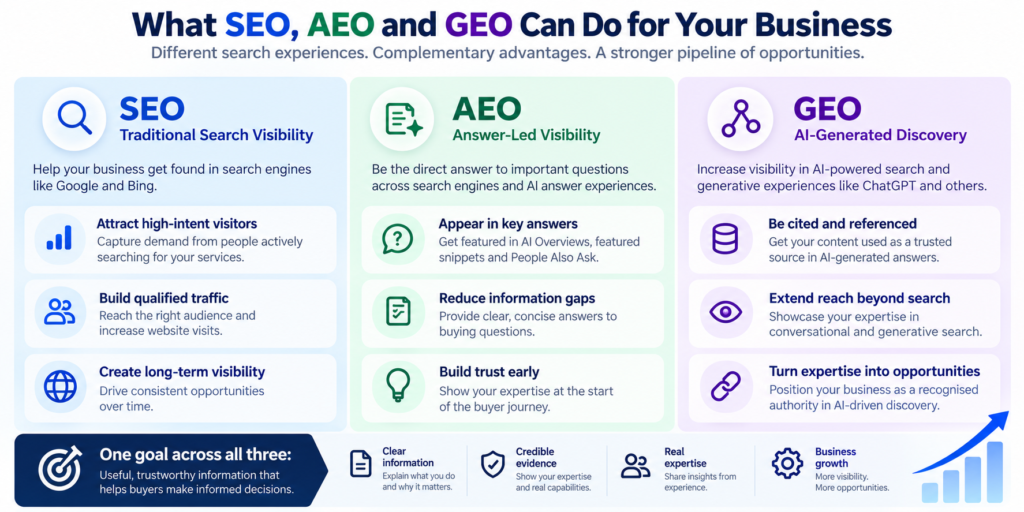
So what does GEO actually mean for a hospital?
The sensible way to think about generative search is not:
“How do we make ChatGPT rank our hospital?”
There is no guaranteed formula for that.
Instead, ask:
Does our website clearly explain who we are, what we do, where we operate, which specialists we have and which clinical questions we can answer?
Does the content contain useful information rather than generic statements?
Are important facts easy to find?
Are related pages connected?
Is the information consistent across the website and relevant local profiles?
Is the content written and reviewed with the appropriate level of clinical care?
Those are valuable questions regardless of whether the eventual visitor comes through Google Search, an AI-generated answer, a map result or a direct referral.
The strongest response to AI search is therefore not to write for machines.
It is to make your expertise easy to understand and easy to verify.
Structured data helps search engines understand your website. It is not a shortcut to rankings.
Structured data deserves a place in a hospital’s technical SEO strategy, but it should not be oversold.
It gives search engines explicit information about what a page represents and can make eligible content available for certain search features.
But implementation does not guarantee that a rich result will appear.
Google explicitly states that even when structured data is correctly implemented, search features are not guaranteed. It also requires structured data to accurately represent the visible content on the page.
For hospitals, structured data can therefore support a broader technical foundation around appropriate organisational, local, article, breadcrumb and profile information where those implementations genuinely match the page.
The order matters:
Useful content first. Clear architecture next. Technical accessibility alongside it. Structured data where it genuinely helps.
Not the other way around.
Local SEO still matters for hospitals
Healthcare has a strong local component.
Someone searching for a cardiologist, paediatrician or orthopaedic surgeon will often care about location, availability and practical access.
That makes local search an important part of hospital visibility.
Google’s current Business Profile guidance requires businesses to represent themselves accurately and consistently in the real world. Its guidance also allows certain public-facing departments within hospitals to have their own profiles when they operate as distinct entities. Individual practitioners may also qualify under specific conditions.
That does not mean a hospital should create a separate profile for every department simply because it can.
The better question is:
Which locations, departments and practitioners genuinely have distinct public-facing identities and meet Google’s requirements?
Once that is established, accuracy becomes the priority.
Names, addresses, telephone details, categories, opening or consultation information and website destinations should all represent the real organisation accurately.
Local SEO is not separate from hospital SEO.
It is one part of the same discovery journey.
Search visibility is only useful if the next step is clear
This is where SEO reports often stop too early.
They show rankings.
Impressions.
Clicks.
Organic traffic.
Those metrics matter, but they do not tell the whole story.
Imagine a patient lands on a hospital page after searching:
“knee pain when climbing stairs.”
They read the information.
What happens next?
If the page ends with a generic “Read our latest blogs” section, the search journey has effectively stopped.
The patient may need something much more useful: information about when to seek assessment, a link to orthopaedic care, relevant specialists, location information or an appropriate way to request an appointment.
The call to action should reflect the patient’s intent.
A symptom page does not necessarily need a large “Book Now” button.
Sometimes the appropriate next step is:
Find an orthopaedic specialist.
Sometimes:
Learn more about knee conditions.
Sometimes:
Request an appointment.
The point is to remove unnecessary friction between information and action.
That is where SEO and conversion strategy meet.
What should hospitals measure?
A hospital should not judge SEO entirely by total website traffic.
A large amount of traffic to a general health article may have very little connection to the services the hospital actually needs to grow.
A more useful measurement framework connects search visibility with service-line and patient actions.
| Area | What to monitor |
| Search visibility | Organic impressions, clicks and query trends |
| Priority specialties | Visibility and traffic for important service lines |
| Local search | Business Profile visibility and interactions |
| Content | Engagement with symptom, condition and treatment pages |
| Doctor discovery | Visits to provider profiles and relevant actions |
| Conversion | Calls, enquiries and appointment actions |
| Technical health | Indexation, crawlability and page experience |
| Content quality | Clinical review, accuracy and freshness |
The exact KPIs will differ from one hospital to another.
A private hospital with online booking may care deeply about completed appointment actions. A multi-location healthcare group may need to understand location-level demand. A specialist clinic may focus heavily on doctor discovery and consultation enquiries.
The principle remains the same:
Measure whether search is bringing the right people to the right part of the organisation.
A practical starting framework for hospital marketing teams
If your hospital is starting from scratch, or if your existing SEO programme has become a collection of disconnected activities, bring it back to six areas.
1. Search intent and keyword research
Understand how patients describe symptoms, conditions, treatments, specialists and local needs.
2. Website structure and content
Build clear relationships between specialties, conditions, symptoms, treatments, doctors and locations.
3. Doctor and provider profiles
Make clinical expertise discoverable and give patients enough information to evaluate the right specialist.
4. Local SEO
Keep hospital, location, department and practitioner information accurate wherever a legitimate local presence exists.
5. Technical SEO
Make important pages crawlable, indexable, mobile-friendly and easy for search systems to understand. Use structured data where appropriate and ensure it matches visible content. Google’s current AI search guidance reinforces these same technical fundamentals rather than introducing a separate technical layer for AI search.
6. Conversion and measurement
Connect search visibility with meaningful actions such as enquiries, calls, specialist discovery and appointments.
The real opportunity is not to publish more. It is to become more useful.
Hospitals already have something most websites are trying very hard to manufacture:
expertise.
Doctors answer patient questions every day. Specialists explain procedures. Departments manage complex conditions. Nurses explain preparation and recovery. Consultants help patients understand treatment choices.
The problem is that much of that expertise never becomes useful digital information.
It remains inside consultations, brochures, PDFs, department pages or disconnected sections of a website.
SEO can help close that gap.
A patient asks a question. The hospital has the expertise to answer it. The website should make that answer discoverable, understandable and trustworthy.
And when the patient is ready to move from information towards care, the next step should be clear.
That is the real opportunity in SEO for hospitals in 2026.
Not chasing every keyword.
Not creating hundreds of generic articles.
Not adding AI terminology to an old SEO strategy and calling it GEO.
Instead, build a website that understands the questions patients are asking, connects those questions to the hospital’s clinical expertise, makes the right specialists easy to discover and gives people a sensible path towards care.
The search experience may continue to change. AI will continue to evolve. New interfaces will appear.
But the fundamental question for a hospital remains surprisingly simple:
When someone needs the expertise you provide, can they find you, understand you and take the next step?
That is where a serious hospital SEO strategy should begin.
Looking to connect with more patients when they need care most?
Explore tailored digital marketing for hospitals with Retentia Technology.