


01. Let’s Look at How Today’s Industrial Buyers Actually Search
Let’s take a practical example.
A procurement manager needs a manufacturer for precision CNC machining. A few years ago, the search might have been straightforward:
“CNC machining companies near me.”
Google would return a list of businesses. The buyer would open four or five websites, review their services, look for relevant experience and compare the companies before making contact.
That search behaviour still exists. But the way people express their requirements and explore potential suppliers is expanding.
A buyer might now ask:
“Which manufacturers in the UK provide five-axis CNC machining for aluminium aerospace components, with tight dimensional tolerances and AS9100 certification?”
This is a much more specific requirement. The buyer is communicating the manufacturing process, material, application, location and qualification criteria in a single query.
Google’s AI-powered search experiences can interpret more complex questions, explore related subtopics and present supporting links. Its AI Mode, for example, can use a technique called query fan-out, exploring multiple related searches to develop a response.
Google for Developers
What does this mean for manufacturers?
The initial evaluation can begin before a buyer reaches your website. Search results may provide summaries, business information and links that help someone decide which suppliers are worth investigating.
There is another important development. Industrial sourcing platforms are also becoming more specific in how they help buyers find suppliers.
Take Thomasnet’s Smart Search as an example. Buyers can search using parts, services, capabilities, technical specifications, certifications and location. They can then filter and evaluate potential suppliers.
help.thomasnet.com+1
This tells us something about the direction of industrial supplier discovery: buyers need to identify technical suitability, not simply find a company operating in a particular industry.
The 2026 State of Marketing to Engineers research by GlobalSpec and TREW Marketing, conducted in collaboration with Elektor, provides further evidence:
- 62% of the technical buying process happens online before buyers engage with sales.
- 69% of technical buyers use generative AI during purchasing.
- 75% have noticed AI-generated summaries in search results.
- Technical buyers rate their trust in generative AI answers at just 4.7 out of 10.
GlobalSpec Advertising+1
That last finding matters. Buyers are exploring AI-generated answers, but they are not necessarily accepting everything those answers tell them.
They still need reliable information and supporting evidence.
Here is the question manufacturers should be asking: When a buyer describes a requirement that matches your production capabilities, does your digital presence provide enough information for your business to be considered?
Your website is no longer important only when somebody visits it. Its information can influence whether your business enters the buyer’s consideration set in the first place.
02. Your Website Might Be Losing Opportunities Before Your Sales Team Gets Involved
Let’s look at what happens after a buyer discovers a potential manufacturer.
They want to establish whether the business can actually deliver what they need. They may look for:
- Manufacturing processes and equipment capabilities.
- Materials handled and available grades.
- Dimensional tolerances and production capacity.
- Industry-specific experience.
- Quality certifications and compliance standards.
- Previous projects and technical references.
- Locations served and delivery capabilities.
Now consider two manufacturing websites.
Website A:
“We are a leading manufacturer of high-quality precision engineering components, offering innovative solutions to customers across multiple industries.”
Website B:
“We provide five-axis CNC machining for aluminium and stainless-steel components, supporting low-volume prototypes and production requirements. Our capabilities include complex geometries, precision finishing and documented quality inspection.”
The second description gives the buyer something concrete to evaluate. It communicates processes, materials and production scope.
Of course, the information must reflect the manufacturer’s actual capabilities. The point is that technical specificity gives buyers a much clearer basis for evaluation.
This is particularly important as buyers increasingly conduct their own research.
In its March 2026 research, Gartner reported that 67% of B2B buyers prefer a rep-free purchasing experience. Its survey also found that 45% had used AI during a recent purchase. The study covered 646 B2B buyers.
For manufacturers, this raises a practical question.
If a buyer wants to establish whether you can manufacture a particular component, should they have to contact your sales team just to find out whether you work with the required material or production process?
Some questions will always require a technical conversation. But basic capability information, certifications, process descriptions and relevant documentation should be available before that conversation.
There is also a second problem: technical information that exists but is difficult to find.
Perhaps your production capabilities are mentioned in a downloadable brochure. Your certifications appear in an image. Your material specifications are buried in a product catalogue. Your website has no dedicated page explaining the manufacturing processes you offer.
A human visitor might eventually find this information. But search engines also need accessible, clearly organised content to understand what your business offers.
This is where website architecture and content strategy become important.
The issue is not always that manufacturers lack information. Sometimes, the information buyers need has never been organised around the way they search and evaluate suppliers.
Demonstrating Technical Expertise Without Disclosing Confidential Information
For manufacturers working with OEMs and specialised industries, not every technical capability or customer project can be showcased publicly.
Instead, focus on approved manufacturing capabilities, general process information, material expertise, certifications and anonymised project examples. This allows your website to demonstrate technical credibility without exposing proprietary information.
03. Five Stages Between Being Discovered and Winning an RFQ
Let’s put the buyer’s journey into a practical framework.
A manufacturer needs to think beyond the question of whether a website ranks. We need to understand what happens between the initial search and the eventual enquiry.
I would break this into five stages.
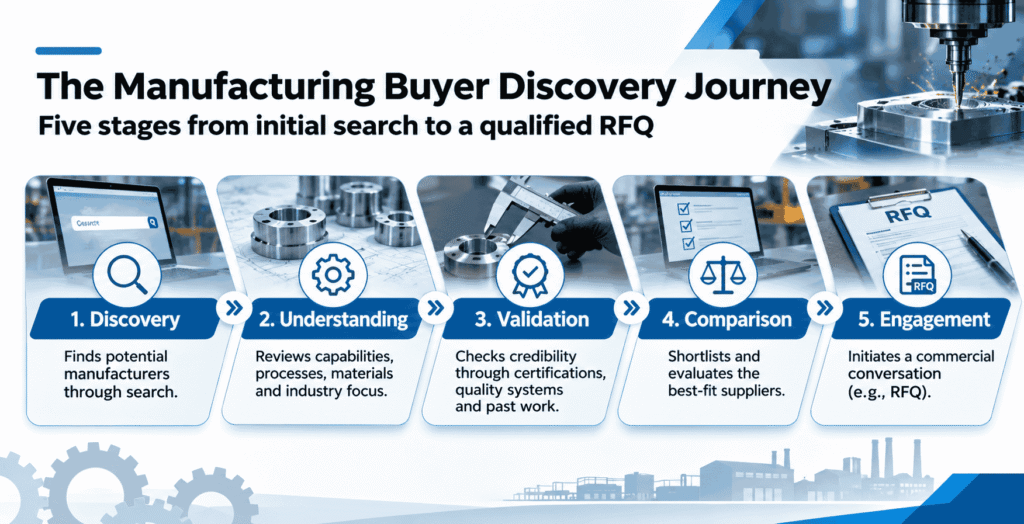
The Manufacturing RFQ Discovery Journey
| Stage | Buyer’s question | What your digital presence needs to provide |
| 01. Discovery | Can I find a manufacturer for this requirement? | Search visibility for relevant processes, products and applications |
| 02. Understanding | Does this company actually manufacture what I need? | Clear descriptions of capabilities and services |
| 03. Validation | Can this supplier meet my technical requirements? | Specifications, certifications, documentation and evidence |
| 04. Comparison | How does this manufacturer compare with alternatives? | Relevant experience, production details and credible differentiation |
| 05. Engagement | Can I confidently submit an enquiry? | Accessible RFQ forms and clear contact routes |
Think about this journey from a buyer’s perspective. Finding a manufacturer is only the starting point. They still need to establish whether its capabilities match their requirements, whether the business is credible and whether it is worth initiating a commercial conversation.
A gap at any stage can take a potential supplier out of consideration.
McKinsey’s 2024 B2B Pulse Survey, which covered nearly 4,000 decision-makers across 34 sectors and 13 countries, found that B2B buyers use an average of ten interaction channels during their purchasing journey. Company websites, in-person sales and video conferences were among the most frequently used touchpoints.
McKinsey
This is why the website cannot be treated as a standalone marketing asset. It needs to work alongside sales conversations, professional networks, industry platforms and other discovery channels.
The five-stage framework gives us a useful way to assess that experience.
Ask yourself: At which of these five stages could a potential buyer struggle to find the information needed to move forward?
That is where your digital strategy needs attention.
04. Ranking for Keywords Is One Thing. Ranking for Buyer Intent Is Another.
Now let’s get into SEO itself.
When manufacturers approach SEO, one of the first things they often ask is:
“Which keywords can we rank for?”
That’s a reasonable starting point, but it is not enough to build a commercially useful strategy.
Imagine a company specialising in precision metal fabrication. It could target broad keywords such as:
- Metal fabrication
- Engineering services
- Industrial manufacturing
- CNC machining
These terms describe industries or services, but they do not necessarily communicate what the searcher needs.
Compare them with:
- Custom stainless-steel sheet metal fabrication.
- Precision aluminium CNC machining for aerospace.
- Low-volume metal stamping for automotive components.
- Contract manufacturing for industrial equipment.
- ISO 9001-certified precision component manufacturer.
The difference is the level of intent.
A buyer searching for a specific process, material or application may have a much clearer requirement than someone entering a broad industry term.
The RFQ Search Intent Matrix
I would organise manufacturing keyword research into five categories.
| Search category | Example search | What it tells us |
| Process-based | Five-axis CNC machining services | The manufacturing process required |
| Material-based | Stainless steel 316L precision machining | The material specification |
| Application-based | CNC components for aerospace equipment | The intended application |
| Capability-based | High-tolerance aluminium component manufacturer | The required production capability |
| Transactional | Custom CNC machining supplier RFQ UK | The intention to identify and contact a supplier |
These categories should inform your website structure.
For example, a manufacturer offering CNC machining, sheet metal fabrication and injection moulding should not necessarily communicate all three capabilities through one generic services page.
Each major capability deserves a page that explains what the company actually does, the materials it works with, the applications it supports and the requirements it can accommodate.
The same applies to industry-specific pages, provided the manufacturer genuinely serves those industries and can demonstrate relevant expertise.
How do you identify the right keywords?
Start with your existing commercial knowledge.
Speak to your sales and engineering teams. What do customers ask before requesting a quotation? Which materials generate the most enquiries? Which production processes are commercially important? What specifications repeatedly appear in RFQs?
Then validate those observations using:
- Google Keyword Planner.
- Google Search Console.
- Search engine results analysis.
- Competitor keyword research.
- Industry directories and supplier platforms.
- Customer enquiry records.
Do not assume that a phrase with the highest search volume will produce the best business opportunity.
A relatively low-volume search for a specialised manufacturing capability may be more commercially valuable than a broad term attracting thousands of unrelated visitors.
The objective is to build a keyword strategy around the manufacturing work you want to win, not simply the traffic you want to attract.
05. What Happens When Your Buyers Start Asking AI Instead of Just Googling?
We have discussed how buyers are becoming more specific in their searches. Now let’s look at another change: the way search results themselves are presented.
Google is introducing more AI-powered experiences into search. AI Overviews and AI Mode can help users explore complex subjects, ask follow-up questions and compare information from different sources.
ChatGPT, Perplexity and other AI platforms are also becoming part of the research process.
For manufacturers, this creates a new consideration.
Your business may need to be discoverable not only through conventional search listings but also through the information AI systems retrieve and use when responding to relevant questions.
Let’s understand the terminology without getting carried away by the marketing language.
SEO: Search Engine Optimisation
SEO focuses on improving a website’s visibility in organic search results.
For a manufacturer, this includes making sure relevant service pages, product pages and technical resources can be discovered for searches related to its capabilities.
AEO: Answer Engine Optimisation
AEO focuses on making information useful and accessible to systems that provide direct answers to questions.
For example, a manufacturer publishing a detailed explanation of the differences between CNC milling and CNC turning is addressing a specific technical question.
The content should explain the distinction clearly, provide relevant context and help the reader understand which process may suit a particular application.
GEO: Generative Engine Optimisation
GEO refers to efforts to improve a brand’s visibility and representation in generative AI responses.
For example, someone might ask an AI platform:
“Which manufacturers offer precision injection moulding for medical device components?”
A business wants its relevant capabilities and supporting information to be discoverable and accurately represented when systems answer such questions.
However, appearing in an AI-generated recommendation is not something a business can guarantee through a particular optimisation technique.
SEO, AEO and GEO: How They Connect
| Discipline | Primary objective | Manufacturing application |
| SEO | Organic search visibility | Rank for relevant manufacturing and RFQ searches |
| AEO | Direct-answer visibility | Provide clear answers to engineering and procurement questions |
| GEO | Generative AI visibility | Make manufacturing expertise discoverable in AI-assisted research |
These are overlapping approaches, not three completely separate marketing systems.
Google’s official guidance is particularly relevant here. It confirms that the same fundamental SEO practices apply to AI Overviews and AI Mode. There are no additional technical requirements or special schema markups that guarantee inclusion.
Google for Developers
Google also explains that AI Mode can handle nuanced questions and complex comparisons, exploring related searches to develop its responses.
So, what should manufacturers actually do?
- Make important technical information accessible as text on their websites.
- Publish clear, well-supported explanations of their manufacturing capabilities.
- Maintain accurate company, product and service information.
- Use structured data where appropriate and ensure it matches visible page content.
- Build relevant internal links between manufacturing processes, materials and applications.
- Ensure important pages are crawlable and eligible for indexing.
There is no need to create an entirely separate website for AI search.
You need a website that communicates your business accurately, provides useful information and follows established search fundamentals.
If you want to explore the relationship between traditional SEO and emerging AI search experiences in more detail, we have covered the subject in our guide: SEO and AI Search: The Essential Guide.
06. Can Search Engines Actually Understand What Your Factory Does?
Let’s move from search behaviour to the information your website actually contains.
Imagine a manufacturer offering precision machining services.
The homepage mentions CNC machining. The services page says the company provides custom engineering solutions. A downloadable brochure contains some equipment details.
But where does a buyer find the information about:
- Available machining processes?
- Materials and grades handled?
- Maximum component dimensions?
- Tolerance capabilities?
- Prototype and production volumes?
- Quality inspection procedures?
- Industry-specific applications?
If these details are important to your customers, they should not remain hidden in a brochure or an occasional paragraph on the homepage.
They need to be organised into useful, accessible website content.
The Manufacturing Digital Authority Model
I would approach this through five connected pillars.
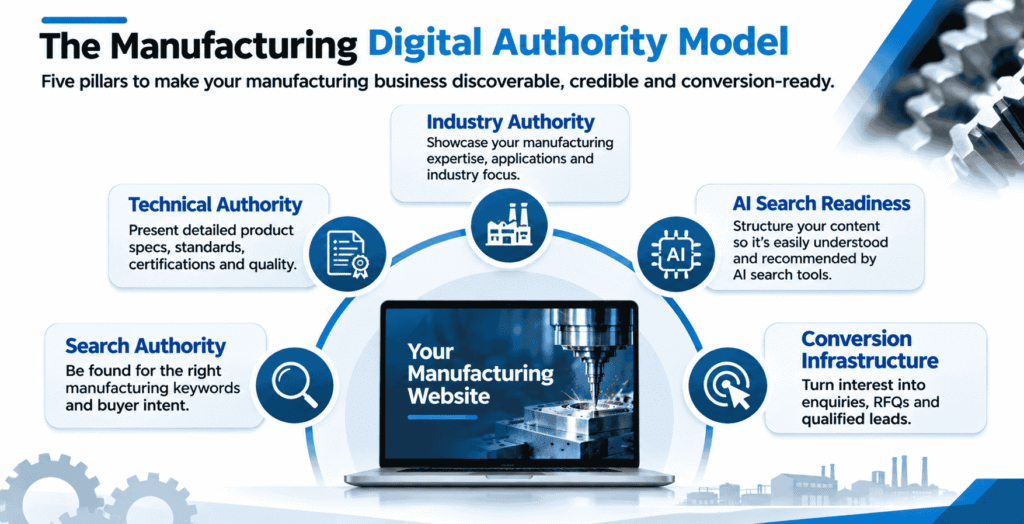
1. Search Authority
Your website needs to establish clear relationships between the business and the searches relevant to its products and services.
This involves keyword research, technical SEO, page optimisation and a logical website structure.
For example, a company offering aluminium die casting should have content that accurately communicates that capability, rather than relying exclusively on broad terms such as engineering solutions.
2. Technical Authority
This is particularly important for manufacturing businesses.
Technical buyers need evidence that a supplier understands the requirements of their application.
Useful content may include:
- Material grades and properties.
- Manufacturing process explanations.
- Dimensional tolerances.
- Production capacity.
- Surface finishing options.
- Technical drawings and CAD resources.
- Quality certifications.
- Inspection and testing procedures.
Where possible, provide important information in searchable HTML rather than relying entirely on downloadable documents.
PDFs still have value. Product catalogues, technical datasheets and engineering drawings should remain available where appropriate. The objective is to ensure that essential information is also accessible through the relevant website pages.
3. Industry Authority
Does your website demonstrate experience in the industries you serve?
A manufacturer supplying automotive, aerospace and industrial equipment companies should explain the relevant applications, production requirements and experience for each sector.
This is where original technical articles, application guides, project examples and expert contributions become useful.
A generic article about the benefits of CNC machining is unlikely to communicate the same level of expertise as a detailed explanation of machining considerations for a particular material or industrial application.
Where a manufacturer has genuine project experience, document it. Explain the challenge, manufacturing approach and verified outcome. Never manufacture case-study results to fill a content gap.
4. AI Search Readiness
Make sure important information is accessible, clearly organised and supported by credible evidence.
Use descriptive headings, accurate company information, relevant internal links and appropriate structured data.
Structured data can help search engines interpret information about an organisation, product or article. However, it does not guarantee higher rankings or AI citations.
5. Conversion Infrastructure
Your website must provide a clear route from technical evaluation to commercial engagement.
That means relevant product and service pages, accessible enquiry routes, RFQ forms and appropriate opportunities to submit technical documentation.
These five pillars work together. Search visibility introduces the manufacturer, technical authority helps buyers evaluate its suitability, industry authority builds confidence, AI readiness supports discoverability and conversion infrastructure makes the next step easier.
What should a manufacturing website actually contain?
Here is a practical example of how we might structure a website for a CNC machining manufacturer.
| Website section | Information to include |
| CNC Machining | Overview of machining capabilities |
| CNC Milling | Milling processes, equipment and applications |
| CNC Turning | Turning capabilities and component types |
| Materials | Aluminium, stainless steel, titanium and other supported materials |
| Industries Served | Automotive, aerospace, medical and industrial applications, where relevant |
| Technical Capabilities | Tolerances, dimensions, volumes and finishing |
| Quality & Certifications | Verified standards and inspection processes |
| Case Studies | Documented projects and manufacturing outcomes |
| Request a Quote | RFQ submission and technical drawing upload |
This structure makes it easier for a buyer to navigate the website and locate the information relevant to their requirements.
It also gives search engines a clearer picture of the company’s manufacturing specialisms.
The objective is not to create hundreds of pages. It is to build the right pages around genuine capabilities and distinct buyer requirements.
The Information Architecture Behind SEO for Manufacturing
A manufacturing website needs more than a collection of service pages and downloadable catalogues. Its information should reflect how buyers search for products, processes, materials and applications.
This requires a logical relationship between product categories, manufacturing capabilities, technical resources and relevant industry pages. Search engines should be able to navigate these relationships without encountering duplicate pages or disconnected information.
For manufacturers with extensive product catalogues, this also raises a practical question: how do you turn years of accumulated technical information into a structured, searchable website without rebuilding everything manually?
07. Building a Digital Presence Around What You Actually Manufacture
We have covered search intent, technical content and the changing discovery environment. The next question is how to bring these elements together into a working digital marketing strategy.
A manufacturing company does not need to be present on every platform or publish content on every possible topic.
It needs a strategy that connects its commercial priorities with the places where its buyers research and evaluate suppliers.
I would divide the implementation into six areas.
1. Technical SEO: Make Sure Your Website Can Be Discovered
Start with the foundations.
Review your website’s:
- Crawlability and indexation.
- XML sitemap and robots.txt configuration.
- Page titles, headings and metadata.
- Internal linking and URL structure.
- Mobile usability and page performance.
- Canonical tags and duplicate URLs.
- Structured data where relevant.
A technically sound website gives search engines access to its important pages and helps them understand the information being published.
2. Build a Search Strategy Around Manufacturing Capabilities
Identify the processes, products, materials and applications that matter commercially.
Then map relevant search terms to dedicated website pages.
For example, if you manufacture industrial pumps, your strategy might include separate content around pump types, materials, operating conditions, industries served and specific engineering applications.
Do not create pages simply to target different keyword variations. Each page should offer a meaningful distinction and answer a genuine buyer requirement.
From a Technical Catalogue to a Searchable Website
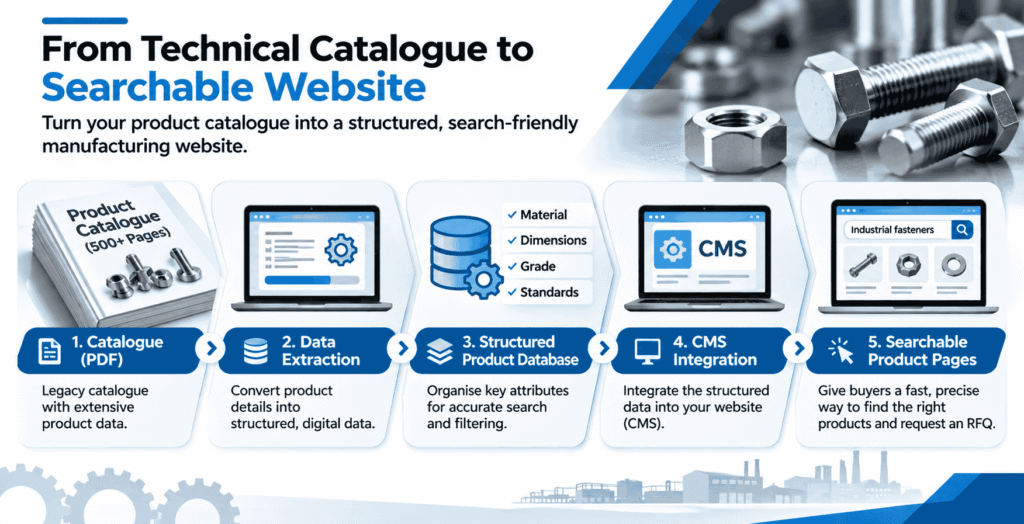
Consider a fastener manufacturer with a 500-page PDF catalogue containing thousands of product specifications.
Simply uploading that PDF to the website will not create a useful search experience. The information first needs to be organised.
A practical implementation workflow would involve:
- Extract: Identify product names, categories, dimensions, materials, grades and applicable standards from the existing catalogue.
- Structure: Convert the extracted information into consistent product records using a spreadsheet or product database.
- Validate: Have the technical team verify specifications, engineering notation and product attributes against the original catalogue.
- Map: Organise products into logical categories and identify which product families deserve dedicated landing pages.
- Integrate: Populate reusable website templates through the CMS or connect an appropriate PIM/ERP data source.
- Optimise: Configure URLs, metadata, internal links, canonical tags and indexation controls.
- Monitor: Check indexing, search visibility, product-page performance and quotation enquiries.
For larger catalogues, this process should be supported by appropriate data-management systems rather than manually creating thousands of individual pages.
The objective is to make existing product knowledge searchable and commercially useful without compromising data accuracy or creating unnecessary website complexity.
3. Develop Technical Content That Engineers and Procurement Teams Can Use
This is where manufacturers have an opportunity to differentiate themselves.
Your engineering and production teams already possess valuable knowledge. The challenge is translating that knowledge into useful digital resources.
Consider developing:
- Material selection guides.
- Manufacturing process comparisons.
- Technical specification pages.
- Engineering application notes.
- Product compatibility guides.
- Troubleshooting resources.
- Technical case studies.
- Downloadable CAD files and datasheets.
The 2026 GlobalSpec and TREW research also highlights the importance of technical content: 85% of technical buyers said they were willing to share their information in exchange for technical content they considered valuable.
This presents an opportunity to develop useful technical resources that support both buyer education and lead generation.
Not every resource needs to be gated. Make essential product and capability information accessible, and reserve forms for genuinely valuable downloads or resources where registration makes commercial sense.
4. Strengthen Your Industry and External Authority
Your website is not the only place where your business needs to establish credibility.
Relevant industry publications, trade associations, supplier directories, engineering communities and specialist media can all contribute to your wider digital presence.
Consider:
- Contributing technical articles to relevant industry publications.
- Earning links from credible manufacturing and engineering websites.
- Publishing original research and technical insights.
- Building relationships with industry associations.
- Securing relevant supplier directory listings.
- Showcasing verified customer projects and certifications.
The emphasis should be relevance and credibility, not simply the number of backlinks acquired.
A link from a relevant engineering publication may be considerably more useful to your business than dozens of unrelated directory links.
5. Use Local and Regional SEO Where It Supports Your Market
Does your manufacturing business serve customers within a particular industrial region? Do you operate facilities in multiple locations? Are you targeting buyers who specifically require a supplier nearby?
These are situations where regional search visibility becomes relevant.
Your website should clearly communicate:
- Manufacturing facility locations.
- Areas and regions served.
- Location-specific production capabilities.
- Relevant contact information.
- Regional customer and industry experience.
For manufacturers with genuine local operations, an accurate Google Business Profile and consistent business information can support local discovery.
However, local SEO should not become the entire strategy. A manufacturer exporting products internationally needs broader national and international search visibility as well.
We have explored the wider role of location-based visibility in our article, 6 Powerful Ways Local SEO Drives Business Success.
6. Make LinkedIn Part of Your Manufacturing Content Strategy
There is another opportunity manufacturers frequently overlook: the professional audience already available through LinkedIn.
Your engineering team, technical leadership, sales representatives and company page can help distribute useful industry information.
For example:
- A new technical guide can become a LinkedIn document post.
- A manufacturing case study can become a short project breakdown.
- An engineering comparison can become an educational discussion.
- A production capability update can reach relevant industry professionals.
- An expert’s perspective can establish familiarity with potential buyers.
The important point is to publish information that is relevant to the audience you want to reach.
A manufacturing company does not need viral content. It needs to remain visible among people who may influence supplier selection and purchasing decisions.
For a deeper look at how professional content is distributed, see our article on How the LinkedIn Algorithm Really Works.
These activities should not operate independently. Your SEO content should support your website, your LinkedIn activity should extend its reach, and your external industry presence should reinforce the expertise you communicate.
This is where a coordinated digital marketing strategy becomes important.
If your website, search strategy and content are being managed separately without a shared commercial objective, opportunities to build consistent visibility can be missed.
At Retentia, our digital marketing solutions for manufacturers are designed around manufacturing capabilities, industry requirements and the way potential customers discover suppliers.
08. From Search Visibility to Qualified RFQs: Connecting the Entire Journey
Let’s assume your SEO strategy is working.
A buyer searches for a manufacturing process you specialise in. Your website appears. They visit your capabilities page, review your technical information and establish that your business could be a suitable supplier.
What happens next?
Can they easily request a quotation?
Can they upload a technical drawing? Can they provide material specifications, component dimensions and estimated production volumes?
Or do they have to search through your website to find a contact email address?
This is where conversion optimisation becomes important.
Make the RFQ Process Easier
A manufacturing website should make it straightforward for a potential buyer to communicate their requirements.
An effective RFQ journey may include:
| RFQ element | Why it matters |
| Product or component description | Establishes what the buyer needs |
| Manufacturing process | Identifies the required production method |
| Material specification | Helps assess technical suitability |
| Dimensions and tolerances | Provides essential engineering information |
| Estimated quantity | Indicates production volume |
| Technical drawing upload | Allows the supplier to review the component |
| Required delivery date | Helps establish the expected timeline |
| Contact information | Enables the sales team to respond |
The exact fields will depend on the manufacturer’s business model and the complexity of its products.
A custom component manufacturer will have different enquiry requirements from a company selling standard industrial products.
The important thing is to avoid treating every enquiry as a generic contact form submission.
Measure the Enquiries That Matter
This brings us back to the difference between website traffic and commercial performance.
A manufacturing SEO campaign should not be judged solely by the number of visitors or keywords ranking on Google.
Consider the following measurement framework:
| Performance area | What to monitor |
| Search visibility | Impressions, keyword positions and relevant search coverage |
| Website traffic | Organic sessions and landing-page performance |
| Buyer engagement | Visits to capability pages, technical downloads and supporting content |
| Enquiries | RFQ submissions, calls and contact forms |
| Lead quality | Relevance of the enquiry, specifications and production requirements |
| Sales pipeline | Qualified opportunities and enquiries progressing into quotations |
| Commercial outcomes | Won business and revenue attributable to marketing, where measurable |
Google Search Console can help you understand which searches are generating impressions and clicks. Google Analytics can help you understand what visitors do after arriving on the website.
Your CRM should then connect enquiries with sales follow-up and commercial outcomes.
One important distinction: an enquiry is not automatically a qualified RFQ, and a qualified RFQ is not automatically a sales opportunity. Each stage needs to be tracked separately.
Understand Where AI Search Fits Into Measurement
AI search visibility is more difficult to measure consistently than conventional organic search.
You can monitor whether your business appears in relevant AI-generated answers, whether your website is cited and whether identifiable AI referral traffic generates enquiries.
However, AI responses can vary between searches, locations and sessions. A single screenshot showing your business in an AI answer is not evidence of sustained visibility.
Establish a defined set of relevant buyer questions and review them consistently.
For example:
- Which manufacturers provide precision CNC machining for aerospace components?
- Who offers custom stainless-steel fabrication for industrial equipment?
- Which suppliers provide low-volume injection moulding for specialist applications?
Record whether your business appears, which sources are cited and whether the information presented is accurate.
This gives you a more useful picture than simply claiming that your website is optimised for AI.
The commercial objective remains the same: attract relevant buyers, help them evaluate your capabilities and make it easier for them to initiate a meaningful enquiry.
09. How Do You Know Whether Your Manufacturing SEO Is Actually Working?
Let’s address a question that often comes up when businesses invest in digital marketing.
“How long before we start seeing results, and how do we know whether the investment is working?”
There is no universal timeline for SEO. Competition, website condition, market demand, content quality and the scope of work all influence performance.
However, there is something manufacturers can establish from the beginning: a measurement system that connects SEO activity with commercial outcomes.
I would divide performance measurement into three levels.
Level 1: Are You Becoming More Discoverable?
Start by measuring whether your website is appearing for the searches that matter.
Monitor:
- Rankings for priority manufacturing and RFQ-related terms.
- Organic search impressions and clicks.
- Visibility of individual product and capability pages.
- Search performance across target locations.
- Relevant brand mentions and AI search citations, where measurable.
A rise in impressions can indicate increased search visibility, but it does not automatically mean the right buyers are finding you.
Level 2: Are the Right People Engaging With Your Website?
Next, examine what visitors do after arriving.
Look at:
- Visits to high-value manufacturing pages.
- Engagement with technical resources.
- Downloads of datasheets and product documentation.
- Visits to RFQ and contact pages.
- Enquiry form completion rates.
If a page attracts visitors but very few progress towards an enquiry, examine whether its content matches their expectations and whether the next step is clear.
Level 3: Is Digital Marketing Contributing to Business Opportunities?
This is where marketing and sales data need to come together.
Track:
- Relevant enquiries generated through organic search.
- Qualified RFQs.
- Quotations issued.
- Sales opportunities created.
- Enquiries progressing into customers.
- Revenue attributable to marketing, where reliable attribution is possible.
A campaign attracting 500 relevant visitors and generating 12 qualified RFQs may be more commercially valuable than one attracting 5,000 visitors with no meaningful enquiries.
The numbers above are illustrative, not industry benchmarks. The actual performance depends on the manufacturer, its market and the commercial value of each opportunity.
Establish a Practical Performance Dashboard
| KPI | Measurement tool |
| Organic search visibility | Google Search Console |
| Keyword performance | Search Console and SEO platforms |
| Website engagement | Google Analytics |
| RFQ submissions | Website conversion tracking |
| Lead qualification | CRM |
| Sales pipeline | CRM and sales reporting |
| AI search visibility | Defined prompt monitoring and referral analysis |
Review these indicators together rather than treating rankings, traffic or AI mentions as standalone measures of success.
The question is not simply whether your website is receiving more visitors. It is whether your digital presence is helping your business reach buyers who have a genuine requirement for what you manufacture.
10. Is Your Digital Presence Working as Hard as Your Manufacturing Operations?
Let’s bring this discussion back to where we started.
You may have invested in advanced machinery, skilled engineering teams, production facilities and quality certifications. You may have spent years developing your manufacturing capabilities and building relationships with customers.
But when a potential buyer searches for a manufacturer with those exact capabilities, what does your digital presence communicate?
Can they find your business?
Can they understand your production capabilities?
Can they verify your technical expertise?
Can they compare your business with other suppliers?
Can they confidently submit an RFQ?
These questions deserve attention because the supplier discovery process is becoming increasingly digital. Traditional search, AI-assisted research, technical publications, industry platforms and professional networks are all part of the wider environment in which buyers evaluate potential suppliers.
Manufacturers need a digital strategy that reflects how their businesses actually operate and what their customers are looking for.
At Retentia Technology, we work with manufacturing businesses to strengthen their digital presence through industry-focused SEO, technical content, website optimisation, search visibility and digital marketing.
The objective is to connect your manufacturing capabilities with the buyers actively searching for them.
Your next customer may already be searching for exactly what you manufacture. Is your business appearing when that search happens?
Explore our Digital Marketing Solutions for Manufacturers or speak with our team about building a digital strategy around your manufacturing capabilities.
Research and external references
The following sources support the research findings and industry observations used throughout this article.
- 2026 State of Marketing to Engineers – GlobalSpec.
- Gartner: 67% of B2B Buyers Prefer a Rep-Free Experience.
- McKinsey: Five Fundamental Truths About B2B Buying Behaviour.
- Google Search Central: AI Features and Your Website.
- Thomasnet: How to Use Smart Search.
- Thomasnet: How to Compare Suppliers.