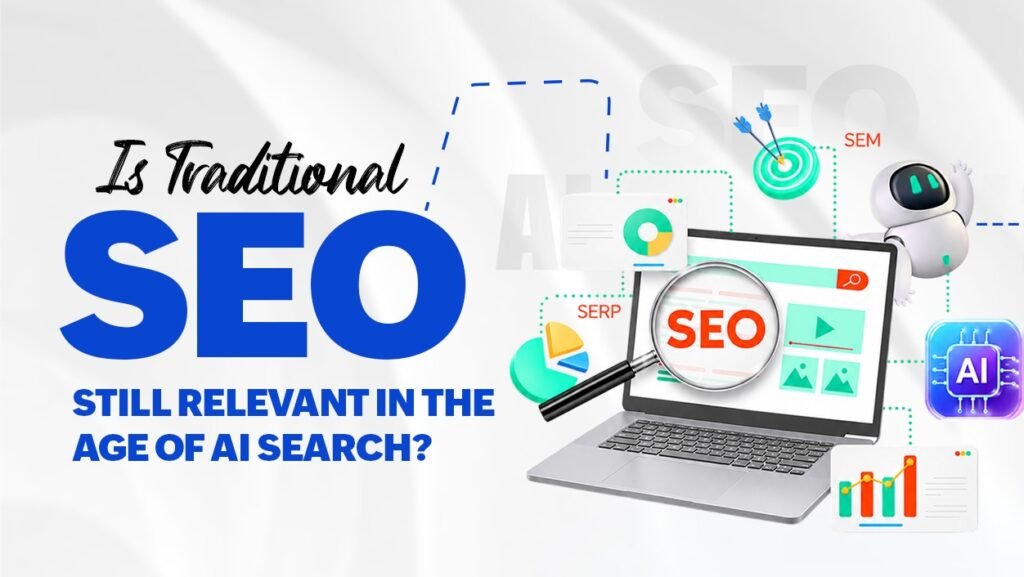
Search is changing. People are finding answers in different places, and businesses are competing for visibility beyond the traditional list of blue links. But does that make SEO less important in the age of AI search?
A potential customer researching a software provider might begin with Google, compare options through an AI-powered search experience, ask ChatGPT for recommendations and visit a company website only when they are ready to evaluate a solution.
The journey is becoming less predictable. The familiar relationship between a search ranking, a website visit and a business enquiry is no longer the whole picture.
This has led to a growing debate about whether traditional SEO is losing its relevance. The more useful question is whether businesses are measuring search visibility in a way that reflects how people now discover and choose suppliers.
Search has changed. The foundations haven’t disappeared.
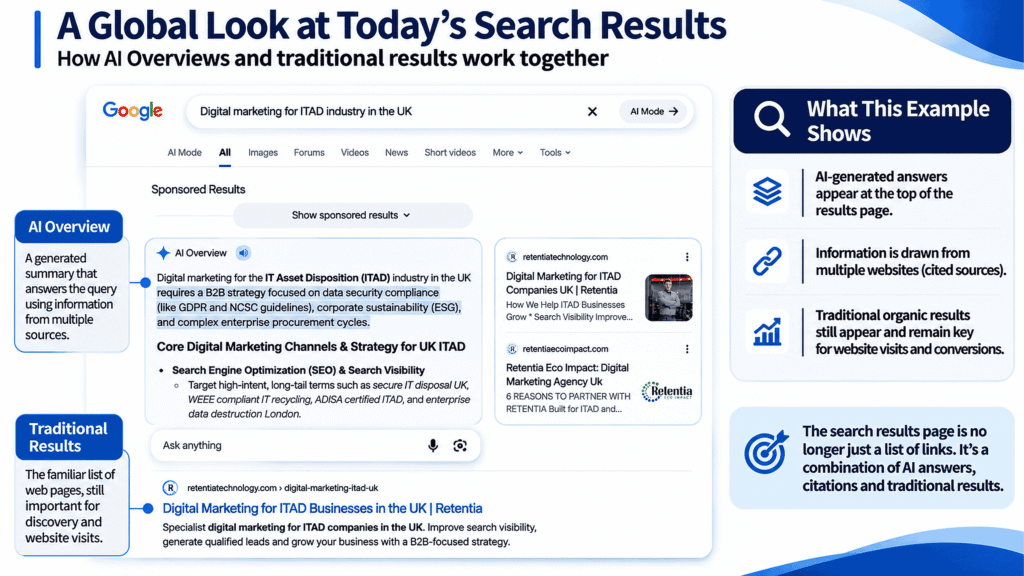
Traditional search gave businesses a relatively familiar route to visibility. Search engines crawled websites, indexed pages and ranked results against a user’s query. Strong technical foundations, relevant content and authority helped pages compete.
AI search introduces another layer. Instead of presenting only a list of results, platforms can synthesise information from multiple sources and provide a direct response, sometimes with links to the websites behind it.
Google’s AI Overviews and AI Mode, for example, can use multiple related searches to explore different aspects of a complex query. ChatGPT Search can also surface relevant websites and cite its sources.
The experience is different, but websites still need to be discoverable, accessible and useful.
Google’s own guidance is explicit: its existing SEO best practices remain relevant to AI features. Pages must meet the usual technical requirements and be eligible to appear in Search. There is no separate AI optimisation checklist or special schema required.
That is an important distinction. AI search changes how information is presented and discovered. It does not make the underlying quality of that information irrelevant.
The real shift is happening between visibility and the click
For years, organic performance was commonly assessed through rankings, impressions, clicks and sessions. These remain useful metrics, but they do not tell the entire story when search experiences answer more questions before a visitor reaches a website.
Consider a business researching an ITAD software provider.
It might use an AI search tool to understand the difference between IT asset disposition platforms, compare compliance capabilities and identify potential suppliers. A provider could influence that evaluation by appearing in a cited source, even if the user does not immediately visit its website.
The website visit may happen later, through a branded search or a direct visit. In some cases, it may not happen at all.
This is why a decline in organic clicks cannot automatically be interpreted as a decline in brand visibility or commercial influence. Equally, an AI mention should not be treated as a qualified lead.
Visibility, consideration, website traffic and conversion are connected, but they are not interchangeable.
The numbers deserve a closer look
The shift is already visible in third-party research.
An Ahrefs study published in February 2026 found that the presence of an AI Overview correlated with a 58% lower average click-through rate for the top-ranking page, compared with similar informational searches without an AI Overview.
That is a significant finding, but it needs context. It is an observed correlation across the study’s keyword dataset, not a prediction that every website will lose 58% of its clicks.
Zero-click behaviour also predates generative AI. SparkToro’s 2024 research, using Datos clickstream data, found that 58.5% of US Google searches and 59.7% of EU Google searches ended without a click to an external result.
The implication is not that organic search has stopped working. It is that the search results page has long been more than a passageway to websites. AI search is accelerating a change that was already underway.
For businesses, the practical concern is understanding which searches still generate valuable visits, which influence decisions without a click, and where potential customers go next.
What businesses need to rethink
The answer is not to abandon SEO and replace it with a new set of GEO tactics. It is to examine whether the website and its wider digital presence provide enough useful, credible information to support discovery and evaluation.
1. Make the business easy to understand
A search engine or AI system needs to establish what a company does, whom it serves and what distinguishes its offering. Vague service descriptions and disconnected pages make that understanding harder.
Clear service pages, consistent company information, well-defined product capabilities and relevant supporting content help establish context.
2. Build content around real buying decisions
Publishing more articles is not a visibility strategy by itself. Businesses need content that addresses the questions customers ask while researching, comparing and evaluating solutions.
For a software provider, that could mean explaining implementation requirements, integrations, compliance workflows, operational challenges and the limitations of different approaches.
Specific, well-supported information gives readers something useful to evaluate. It also gives search systems clearer material to interpret.
3. Treat technical SEO as essential infrastructure
Crawlability, indexability, internal linking, page performance and accessible content still matter. Important information should be available in a form search systems can retrieve and understand.
For businesses interested in ChatGPT Search, crawler access also matters. OpenAI’s publisher guidance recommends allowing OAI-SearchBot to access website content intended for inclusion in ChatGPT search results.
4. Build credibility beyond the website
A company’s reputation is shaped by more than its own published pages. Industry publications, relevant directories, expert contributions, customer discussions and independent references all contribute to how a business is understood.
This should not become a campaign to manufacture mentions. The objective is to establish a credible presence in the places where customers research and discuss their options.
Measure the journey, not just the ranking
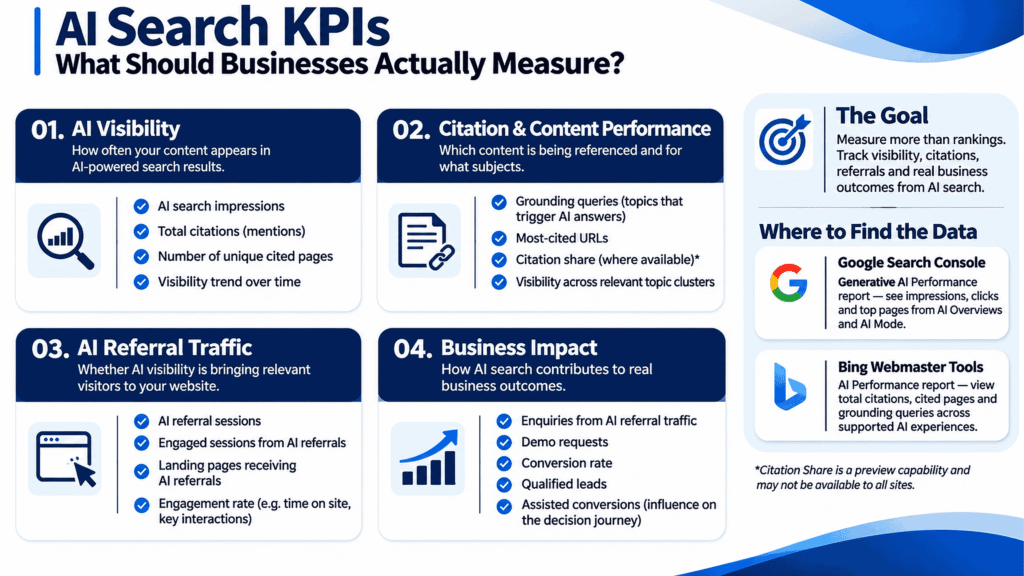
A more useful search performance framework connects four stages:
Discovery
Your audience finds your brand through search engines and AI-powered answers.
Consideration
Relevant content and credible information help build trust and influence decisions.
Website Engagement
Visitors explore your website, evaluate your offering and interact with your content.
Conversion
Interest turns into meaningful business outcomes, from enquiries to qualified leads.
At the discovery stage, examine organic visibility and relevant brand presence. During consideration, look at the quality of enquiries and the topics influencing research. On the website, assess engagement with important service and product pages. At the conversion stage, connect marketing activity to qualified enquiries, demonstrations and opportunities.
Google Search Console and analytics platforms remain important, but their data should be interpreted alongside referral sources, branded search activity and actual business outcomes. No single reporting tool captures every interaction across AI search platforms.
The objective is not to replace established SEO metrics with an equally narrow AI search visibility score. It is to understand how search contributes to commercial outcomes across a longer journey.
SEO needs a wider definition of success
The rush towards GEO and AI search optimisation has created a familiar problem: businesses are being presented with new terminology and tactics before they have established what those activities should achieve.
There is value in improving how content is structured, making information easier to retrieve and understanding how AI platforms discover websites. But none of these should become isolated activities detached from the business’s wider search strategy.
A website that cannot be crawled properly, does not explain its services clearly or offers little useful information will struggle to build sustainable visibility, whatever the optimisation label attached to the work.
Traditional SEO is still relevant. What needs to change is the expectation that success begins and ends with a position on a search results page.
The businesses that adapt well will be those that make themselves genuinely useful and credible wherever their customers go to research a decision.
Want to Understand How SEO and AI Search Work Together?
Explore how SEO, AEO & GEO are shaping the future of online visibility.
Explore Our SEO & AI Search GuideSearch visibility should lead somewhere.
Your SEO strategy should connect discoverability with the questions your customers ask, the services they evaluate and the decisions they make.
Looking for an SEO Agency to Strengthen Your Visibility Across Search and AI Engines?
Talk to our team about your SEO strategy